

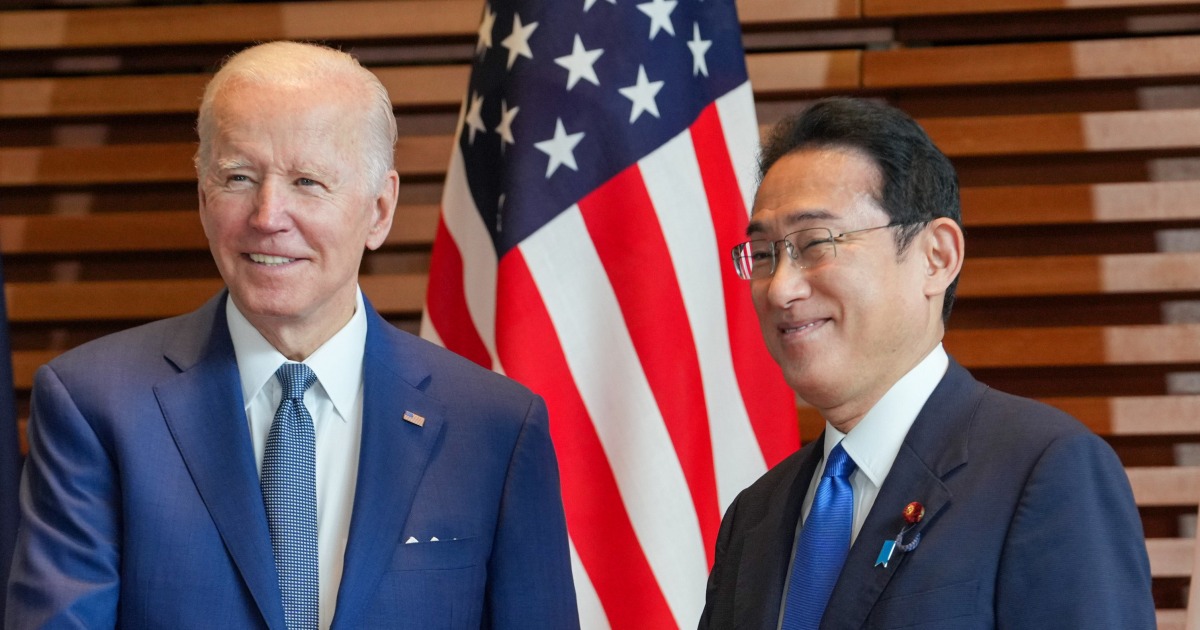
WASHINGTON — President Joe Biden and Japanese Prime Minister Fumio Kishida held extensive talks at the White House on Friday as Japan seeks to build security cooperation with its allies at a time of provocative military action by China and North Korea.
The two administrations were also set to seal an agreement to strengthen US-Japan cooperation in space with a signing ceremony by Secretary of State Antony Blinken and Japanese Foreign Minister Hayashi Yoshimasa.
The Oval Office meeting and signing ceremony at NASA headquarters in Washington will cap off a weeklong tour by Kishida that has taken him to five European and North American capitals to discuss his effort to strengthen Japan’s security.
Biden welcomed Kishida to the White House on Friday morning for the prime minister’s first visit to Washington since taking office in October 2021. Inside the Oval Office, the US president praised Japan. for his “historic” increase in defense spending and promised close cooperation on economic and security matters.

“We met at a remarkable time,” Biden told Kishida, adding later: “The hardest job is trying to figure out how and where we disagree.”
Kishida, speaking through an interpreter, said the two nations «share fundamental values such as democracy and the rule of law» and stressed that their joint role on the world stage «is becoming even greater.»
It all comes as Japan announced plans last month to increase defense spending to 2% of gross domestic product over five years, a dramatic increase in spending for a nation that forged a pacifist approach to its defense after World War II. Historically, Japan’s defense spending has remained below 1% of GDP.
«Japan is stepping up and doing so in unison with the United States,» White House National Security Council spokesman John Kirby said.
Blinken said this week that the US-Japan framework for space cooperation was a «decade in the making» and «covers everything from joint research to working together to put the first woman and person of color on the moon.»
He added that the United States and Japan agree that China is their «biggest shared strategic challenge» and confirmed that an attack in space would trigger a mutual defense provision in the US-Japan security treaty.
Ahead of the two leaders’ meeting on Friday, U.S. and Japanese officials announced an adjustment to the U.S. troop presence on the island of Okinawa, in part to enhance anti-ship capabilities that would be needed in the event of a Chinese incursion into Taiwan or other hostile acts. in the region. Japan is also beefing up defenses on its southwestern islands near Taiwan, including Yonaguni and Ishigaki, where new bases are being built.
Japan’s push to increase defense spending and coordination comes as concerns grow that China could take military action to seize Taiwan and that increased North Korean missile tests could portend that the nation in isolation it will achieve its nuclear ambitions.
The talks with Biden, a Democrat, «will be a valuable opportunity to confirm our close cooperation to further strengthen the Japan-US alliance and our joint effort to achieve a free and open Indo-Pacific,» Kishida told reporters just before leaving Japan for his five-country tour.
His meeting with Biden is the latest face-to-face in a week of talks with other Group of Seven leaders that focused largely on their efforts to increase Japan’s defense spending and urge the leaders to improve cooperation.
With British Prime Minister Rishi Sunak, he cemented Japan’s first defense deal with a European nation, one that allows the two countries to conduct joint military exercises.
Kishida also spoke with Canadian Prime Minister Justin Trudeau, Italian Prime Minister Giorgia Meloni and French President Emmanuel Macron about their hopes for enhancing security cooperation between Japan and their respective nations. Germany was the only G-7 country not on Kishida’s itinerary.
Japan last month announced plans to buy US-made Tomahawks and other long-range cruise missiles that can hit targets in China or North Korea under a more offensive security strategy, while Japan, Britain and Italy unveiled plans to collaborate on a next-generation jet. fighter project
“Just a few years ago, there would have been some discomfort in Washington with a Japan that has this kind of military capability,” said Chris Johnstone, a former National Security Council official in the Biden administration who is now the Japan Chair at the Center. of Strategic and International Studies. «Those days are gone.»
Biden administration officials have praised Japan for stepping up after Russia’s invasion of Ukraine. Japan was quick to join the US and other Western allies in imposing aggressive sanctions on Moscow, and Japanese carmakers Mazda, Toyota and Nissan announced their withdrawal from Russia.
Biden administration officials have been pleasantly surprised by Japan’s intensified effort to reconsider its security.
A senior administration official, who insisted on anonymity to discuss negotiations with the Japanese, noted that historically negotiations involving the US force posture on Okinawa have been «incredibly tense, incredibly challenging and difficult» and often They took years to complete. But, the official said, negotiations ahead of this week’s meetings were completed surprisingly quickly.
The official said Biden is expected to raise the case of Lt. Ridge Alkonis, a US Navy officer deployed to Japan who was jailed after pleading guilty last year to the careless driving deaths of two Japanese nationals. in May 2021.
Alkonis’s family says he suddenly fell unconscious at the wheel during a family trip on Mount Fuji. He swerved into parked cars and pedestrians in a parking lot, striking an elderly woman and her son-in-law, who later died.
The Navy officer was sentenced in October to three years in prison, a sentence that the family and US lawmakers called excessively harsh considering the circumstances. Alkonis also agreed to pay the victims $1.65 million in restitution.
The official added that the Biden administration was working «to find a compassionate resolution that is consistent with the rule of law.» Neither Biden nor Kishida responded to questions about Alkonis at the White House, and outside its doors some two dozen protesters called for Alkonis’s release.
Kishida met with Vice President Kamala Harris on Friday before her meeting with Biden to discuss US-Japan space cooperation and other issues.
Harris chairs the National Space Council’s administration. The two discussed strengthening «space cooperation across multiple sectors, including civil, commercial and security space opportunities,» according to a White House summary of the meeting.


