

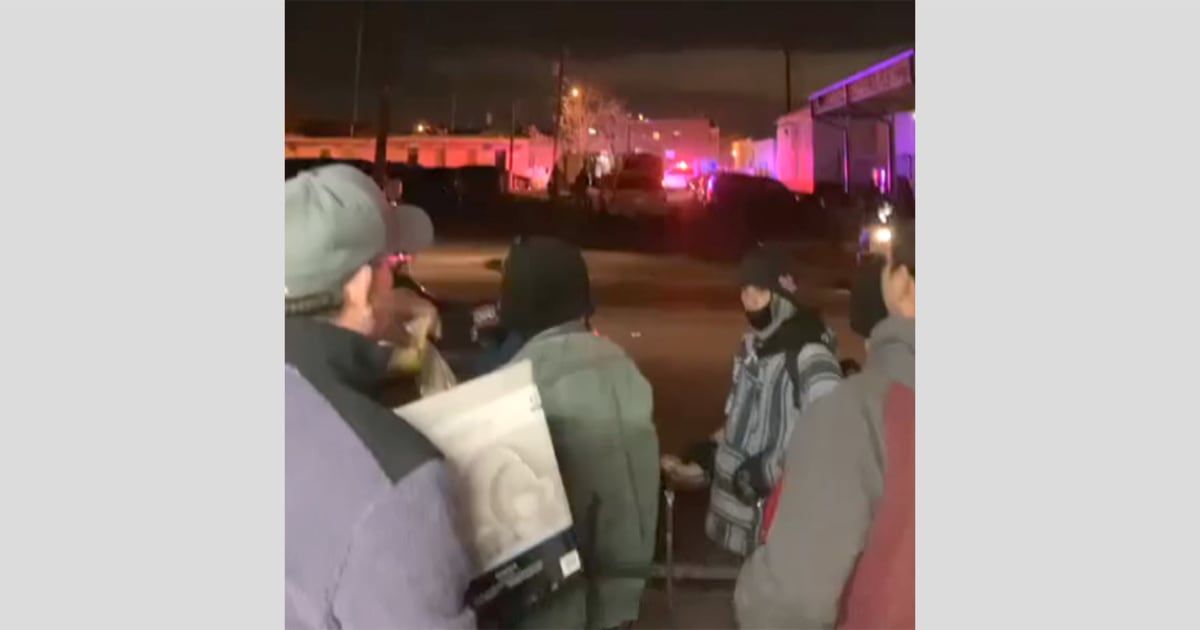
In the week before President Joe Biden’s trip to El Paso, Texas, Customs and Border Protection officers, as well as El Paso city police, began arresting migrants sleeping on the streets in front of the shelter. a Catholic church and the bus station, according to new images obtained by NBC News.
In the videos, border agents can be seen patrolling the streets Tuesday night, driving pickup trucks with flashing lights and whispering tents where families slept. Immigration advocates say the proximity of the arrests to a church shelter may violate Department of Homeland Security policies.
The person who filmed the videos, a shelter volunteer, estimated to NBC News that approximately 100 to 150 migrants had been arrested and that more migrants sleeping at the bus station were apprehended later in the week.

In one video, migrants huddle around a man who is praying aloud: “Cover us, Father! In the name of Jesus, sir. They are people, sir, seeking their salvation, sir. They come looking for a better future, sir. We respect the laws, sir… Father, you have the power to protect us”.
In a statement, the El Paso Customs and Border Protection office said the arrests are in response to migrants evading detention in the El Paso area.
“CBP, which is responsible for securing the US border between ports of entry, uses a layered approach that includes patrolling the border itself, nearby areas and neighborhoods, and conducting checkpoints,” a CBP spokesperson said. agency in El Paso. «In response to migrants evading detention in the El Paso area, the United States Border Patrol has increased the number of agents patrolling the area.»
The number of migrants crossing into El Paso reached record levels, up to 2,500 a day, in mid-December, but has since declined, according to Border Patrol officials.
During the surge, immigrants began arriving at the shelter run by Sacred Heart Church, but some were turned away when the shelter became too crowded, leaving children sleeping on the streets as temperatures dropped below freezing the week before Christmas. Since then, the city has opened more facilities to house the migrants, although many continue to sleep outside the church and next to the bus station.
A Border Patrol officer told NBC News that those arrested had not previously been detained by Border Patrol when they crossed from Juárez, Mexico. They were taken to the El Paso immigration processing center, where they stayed overnight, the official said. From there, they were either sent back to Mexico under Title 42, a Covid-19 border restriction temporarily upheld by the Supreme Court, or given a date to appear in court in the US.
The Biden administration announced new plans Thursday to increase the number of migrants who can return to Mexico under Title 42.
Biden is expected to tout the plan, which also opens more avenues for legal migration, during his visit to El Paso on Sunday.
Locating arrests outside of Sacred Heart Church may violate guidance from the Department of Homeland Security, according to Lisa Graybill, vice president for law and policy at the National Immigration Law Center.
“The cynic in me entertains the possibility that this was a cleanup action meant to cast El Paso in a particular light and the president’s enforcement actions in a particular light,” Graybill said. “I think the irony is that what you see in this video, what our partners on the ground have told us, is in direct contradiction to the kind of reasoned, sensitive and law-abiding proposals that he made at the beginning. of his administration regarding respect for areas such as churches and organizations that are providing social services. So it’s a really painful contradiction.»
In October 2021, Homeland Security Secretary Alejandro Mayorkas sent a memo to the heads of all DHS agencies, in part reminding them that places like places of worship and courthouses are places where undocumented immigrants should not be arrested.
He noted that the areas close to those safe places can also be considered protected.
“We need to consider the fact that an enforcement action taken near, and not necessarily within, the protected area may have the same restrictive impact on an individual’s access to the protected area itself,” Mayorkas said in the memo. «If that were the case, then, to the greatest extent possible, we should not be taking enforcement action near the protected area.»
didi martinez contributed.


