

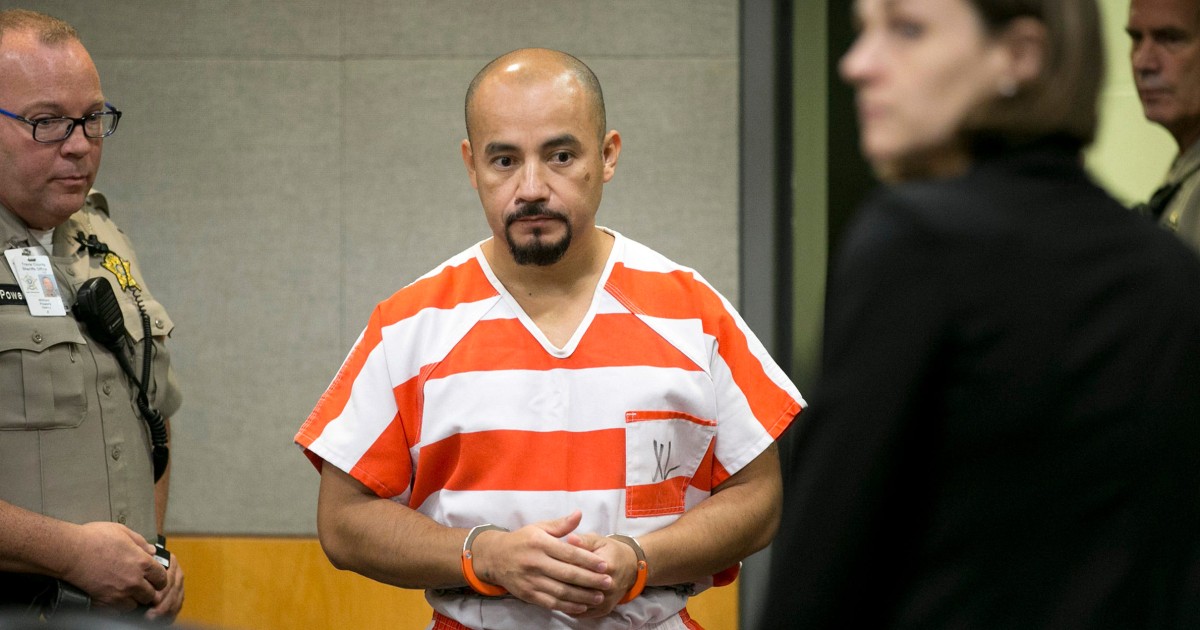
WASHINGTON (AP) — The Supreme Court on Monday revived a Texas death row inmate’s claim that his murder conviction should be overturned because the DNA evidence used in the trial was later found to be unreliable.
The justices threw out an appeals court ruling in favor of the state in a case brought by Areli Escobar, who was convicted of the 2009 murder of 17-year-old Bianca Maldonado. In an unusual move, prosecutors agreed that the evidence was faulty and that there should be a new trial. The Supreme Court remanded the case to a Texas appellate court «for further consideration in light of Texas’ admission of error,» the brief order says.

Escobar was convicted and sentenced to death in 2011 for the murder of Maldonado, who was stabbed and sexually assaulted in her apartment in Austin, Texas. Escobar, who lived in the same apartment complex as the victim, was initially linked to the crime based on comments made by his then-girlfriend, who told acquaintances that he believed she heard him having sex with another woman when she called him on the phone. phone. morning of the murder He also went to his mother’s house later the morning of the murder with bloodstains on his clothes and evidence of injuries, which he said were caused by a fight he got into, according to court documents. At trial, with no eyewitnesses to the crime, prosecutors relied heavily on DNA evidence analyzed by the Austin Police Department’s own laboratory, as well as a private laboratory.
The jury was told that samples taken from Escobar’s clothing showed that Maldonado’s DNA «could not be excluded as a contributor.» Jurors were also told that Escobar’s DNA could also not be excluded as a contributor to DNA evidence found at the crime scene.
After Escobar was convicted in 2011, the police department’s DNA lab was closed following a state investigation that showed evidence of widespread errors and bias.
In 2020, a state judge ruled that Escobar deserved a new trial because «new available scientific evidence demonstrates that the DNA evidence on which this conviction was based was not scientifically reliable,» in part because there was evidence of «suspect-driven bias.» ”. As a result, Escobar’s due process rights were violated, the court concluded.
Prosecutors accepted that finding and notified the Texas Court of Criminal Appeals, which was reviewing the case. However, the appeals court in a January ruling upheld Escobar’s conviction, saying in part that his lawyers had failed to show that the DNA evidence in his specific case was flawed.
In Supreme Court, Travis County District Attorney José Garza, representing the state, urged the judges to rule in favor of Escobar. Prosecutors “offered flawed and misleading forensic evidence” that was “material to the outcome of his case in violation of clearly established federal due process law,” he wrote in court documents.


