

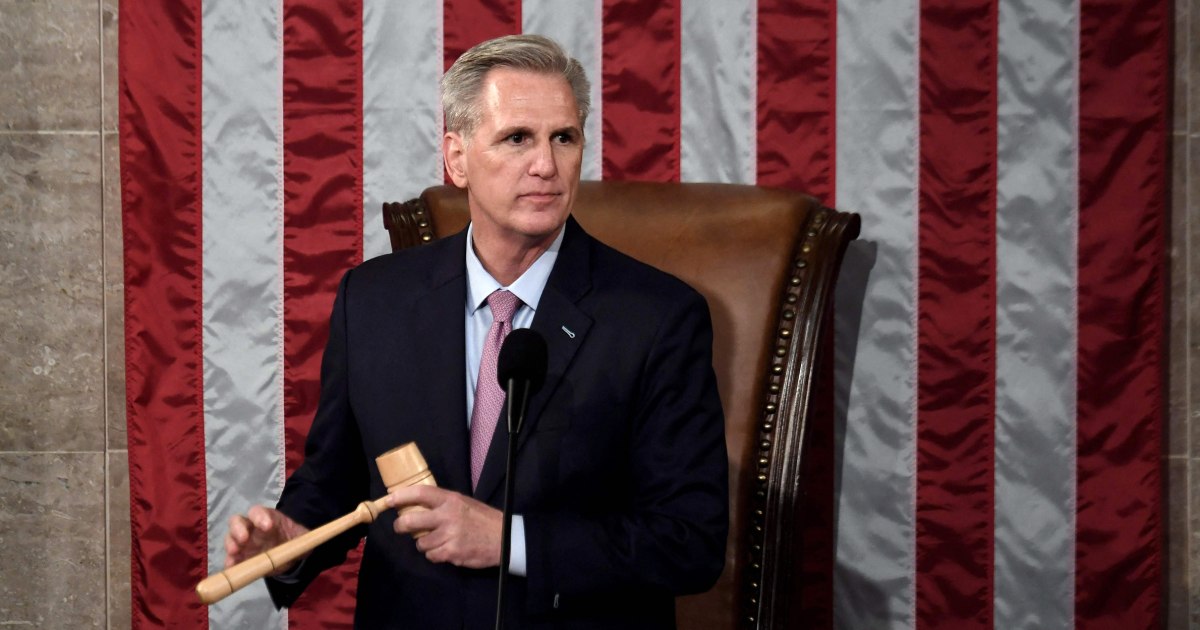
WASHINGTON — In his bid to become Speaker of the House, Rep. Kevin McCarthy agreed to a series of concessions to secure the support of Republicans who originally opposed him. One was a rule change to allow a single member to try to force him out of office.
under the new house rules Passed Monday, it only takes one member of Congress, Democrat or Republican, to file a «motion to quash,» forcing a vote to remove the speaker. Only a simple majority of the House would be needed to pass McCarthy’s removal.

Here’s what you need to know about how a motion to evict would work and the history of the move:
How does a motion to vacate work?
Under the recently adopted rule, any individual member of the House could «offer a privileged resolution declaring the office of president vacant.» The term «privileged” here refers to a matter that takes precedence over regular House business, meaning it is more urgent and must be brought to the full House for a vote.
This is not limited to Republican members; Democrats could also move to vacate.
Procedural votes could be offered to delay the motion, but when it reaches the floor, it would only need a simple majority of the House, or 218 members currently, to pass.
In theory, a small group of Republicans who want to oust the speaker could work with Democrats to reach the votes needed to oust the speaker.
Where did the motion to vacate come from?
The Constitution says nothing about expelling a speaker. In fact, «The House of Representatives shall elect its Speaker» is the just mention of the top job throughout the document. What the Constitution does say is that the Chamber makes its own rules.
Most of those rules are based on the «Jefferson Manual,» which the chamber adopted in 1837 as a guide to parliamentary procedure. «A Speaker can be removed at the will of the Chamber,» the manual states. However, it was President Joseph Cannon in 1910 who first used the motion to overturn as it is now known.
Back then, the speaker was also chairman of the powerful Rules Committee. In a revolt againstTsar Cannon«Progressive Republicans got stripped him of his place in Rules. In a March 19 speech on the House floor, cannon said He only had two options left: resign or «declare the position of Spokesman vacant.»
By offering the motion to expel himself, Cannon put his detractors on record. Republicans voted overwhelmingly to keep him in office. «Cannon, stripped of his power, holds office,» said The New York Times headline the next day.
Has the motion to vacate been used recently?
Republicans considered using the vacancy motion against their own leader, Chairman Newt Gingrich, in 1997 but decided not to.
The next case occurred in July 2015, when the then representative. Mark Meadows of North Carolina, who later served as President Donald Trump’s chief of staff, tried to oust President John Boehner.
While Meadows filed a motion to quash, he said he hoped it would never come to a vote, and it never did. Boehner stepped down as speaker a few months later.
The threshold for filing a motion to override remained at a single member of Congress until 2019, when Democrats won a majority. That year, the Chamber changed the rules to allow a vacancy resolution to be filed only «if offered by order of a caucus or party conference», a much higher bar.
The new package of rules, approved Monday night by the House, changes the procedure for a motion to quash to the way it existed before, giving any member the power to raise it.


