

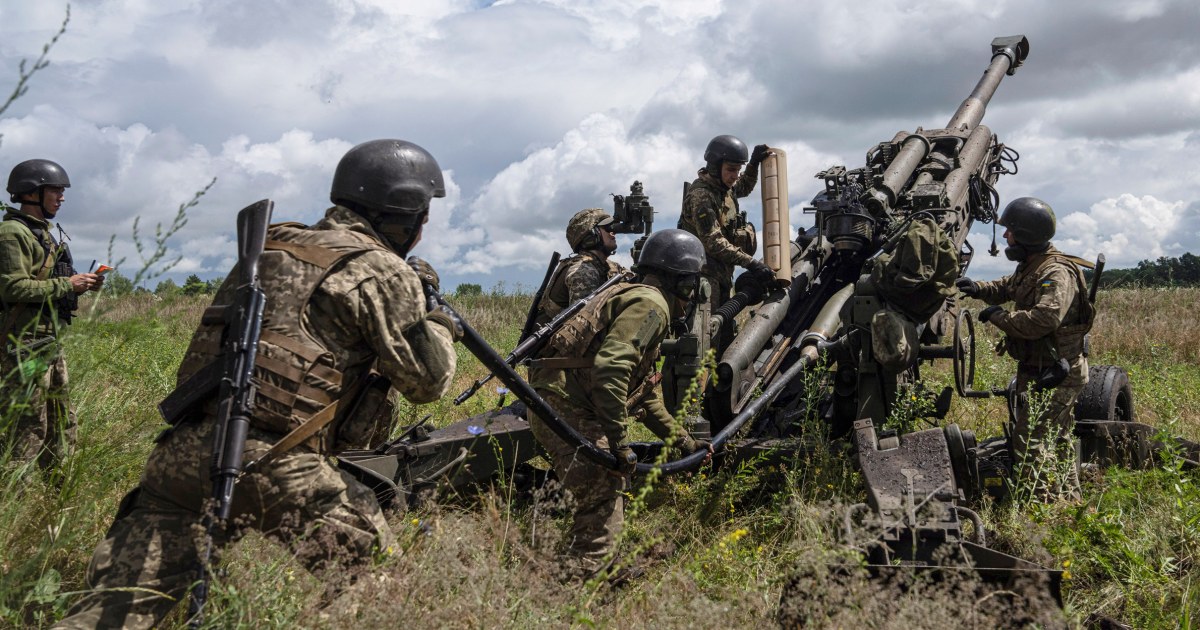
More than 120 countries have banned their use: Congress and human rights groups criticized Russia for firing them last year, and the White House has resisted pressure to send them for months. But now the United States is seriously considering the idea of supplying the Ukrainian military with cluster bombs.
Two senior US officials told NBC News on Thursday that an announcement could come as early as next month, and Army Gen. Mark Milley, chairman of the Joint Chiefs of Staff, spoke at an event at the National Press Club in Washington, DC, on Friday. He, he said the United States was considering the idea of providing the capability to Ukraine, which he said other allies had done before.
“The Ukrainians have asked for it, other European countries have provided some of it, the Russians are using it, there is a decision-making process going on,” Milley said.
While such a decision has been applauded by a bipartisan caucus in Congress, it has also drawn the ire of some Democrats and human rights groups.
Cluster bombs, known as Dual Purpose Enhanced Conventional Munitions, or DPICM, are projectiles fired from an artillery unit or aircraft. Inside are small mini-bombs that scatter over a large area of the battlefield causing widespread destruction. They can be charges intended to penetrate armored vehicles, or they can be broken or fragmented to be more dangerous to people.
They are so effective that they can turn the trenches of a frozen conflict into “death zones”, according to a report published in 2019 by the Royal United Services Institute, or RUSI, a group of British military experts. The problem is that sometimes they can create a minefield of unexploded and untracked bomblets. These “failures” can be difficult to clean up and can explode years later, injuring or killing civilians or other unwanted targets long after the war has concluded.
Worldwide, civilians accounted for 97% of all cluster munition casualties, according to a report in August by Landmine and Cluster Munitions Monitor, a campaign group working to eradicate their use. Children accounted for 66% of all victims where the age group was known, according to the report.

Its use by both sides has been documented during the war in Ukraine, according to Human Rights Watch, an international non-governmental organization. It is unknown how many people the munitions have killed or what area might be affected, but Ukrainian Prime Minister Denys Shmyhal said in April that more than 67,000 square miles of the country had been destroyed by unexploded ordnance. In Ukraine, 226 people were killed in March alone, according to Shmyhal.
Ukraine, long in need of more artillery shells, has called for the destructive shells for more than a year, but President Joe Biden and his administration have hesitated and stood on the brink of destroying thousands of cluster munition shells that they have a “failure” rate of more than 1% and are about to expire in US stockpiles, a move that would have been applauded by humanitarian groups.
But a congressional aide who has worked to push the discussion around sending cluster rounds to Ukraine confirmed that the US now appears ready to send the munitions. They have long been at the top of kyiv’s wish list, and US military policy still depends on them, the aide said.
“If we believe this is the kind of thing that we can drive, train, equip our own forces with, there is absolutely no reason why they shouldn’t go to Ukraine,” said the aide, who requested anonymity to speak freely. on the ongoing discussions. .
A debate in Congress
Last year, 27 Democratic members of the House sent a letter to Biden asking him to join the Convention on Cluster Munitions, an international treaty that bans the transfer and use of cluster rounds. That view has not gone away, though it has grown to acknowledge the debate in Washington over what to do with America’s stockpile of cluster bombs.
Fourteen senators sent a letter to Biden’s national security adviser Jake Sullivan last week saying that while they acknowledge that munitions could give Ukraine a battlefield advantage, “we are convinced that the costs The humanitarian benefits and damage to the coalition unit of providing the US with the munitions would outweigh the tactical benefits.”
Many US allies have signed the Convention on Cluster Munitions. Of the 31 NATO countries, only Estonia, Greece, Latvia, Poland, Romania, Turkey, and the US are not signatories. However, unofficial US policy has long limited capacity sharing with other nations and sought to reduce the use of cluster munitions.
When Russia was accused of using cluster rounds last year in Ukraine, NATO Secretary General Jens Stoltenberg declared the act “inhumane” and “in violation” of international law, even though Ukraine and Russia are not signatories to it. Convention.

But for the past year, members of Congress have been aware of private briefings by US military officials, and that appears to have encouraged their support.
The Pentagon sent its top official focused on Russia, Ukraine and Eurasia to testify before Congress last month about the cluster bombs. Deputy Assistant Secretary of Defense Laura Cooper, one of several Pentagon officials who spoke before Congress, told members that “our military analysts have confirmed that DPICMs would be useful, especially against entrenched Russian battlefield positions.” .
For members of Congress with no military experience, “hearing that validation really helped move the needle,” the congressional aide said.
A bipartisan group in Congress sent a letter to Biden last month, encouraging him to provide the weapons. The group noted that the United States developed cluster munitions during the Cold War “to counter Russia’s numerical and material superiority.”
“They can now be put to their intended use in the defense of Ukraine, and Ukraine’s defense of Europe, and ultimately the national security of the United States,” the letter said.
While support for providing these weapons has grown on both sides of the aisle in recent months, human rights groups and some Democrats say the human cost will outweigh the benefit.
“This is what the military says,” said Mary Wareham, gun advocacy director at Human Rights Watch. “Any weapon would be useful. Chemical weapons would be useful. Cluster munitions for us are in the same category as chemical weapons and are prohibited for a very specific reason, because of the civilian harm and human suffering they cause.”
He added that the White House did not respond to letters sent by Human Rights Watch and a coalition of nongovernmental organizations that oppose the shipment of cluster munitions.
There also appear to have been other private briefings for members of Congress that may have further helped move the needle.
Rep. Jason Crow, D-Col., sent a letter to Defense Secretary Lloyd Austin requesting that the Pentagon make information on cluster munitions “publicly available.” He also raised the issue of “missing” tariffs, when mini-bombs don’t go off.

US policy does not allow the transfer of cluster munitions with a failure rate greater than 1%, under the Foreign Assistance Act. Defense Under Secretary for Policy Colin Kahl admitted the a podcast in february that some of the rounds in the US arsenal have a rate that is just north of that number, although in 2008 the Army stopped purchasing cluster munitions because the miss rate was as high as 5%.
Concerns in Congress about the rate of fraud appear to have been assuaged somewhat in private briefings, Wareham said, mystifying her and members of other human rights groups.
“Without having the information that the Pentagon is giving them, it is difficult for us to understand some of the claims that are being made, but they are quite outlandish,” he said. “Many of the groups and members of Congress who claim to send cluster munitions to Ukraine have never required it for previous wars and conflicts. It’s just Ukraine right now. It’s a wild thing to watch.”
It remains to be seen when or if the ammunition will finally ship.
John Kirby, a spokesman for the National Security Council, declined to comment on the White House’s plans for Friday’s group rounds, but said they continue to “work in unison with the Ukrainians here every day.”
“We are going to continue having those talks with the Ukrainians in the future and as we have done for the last 16 months,” he said. “We will continue to review those requests and adapt them as appropriate, but I do not have a decision or announcement on anything new today.”


