

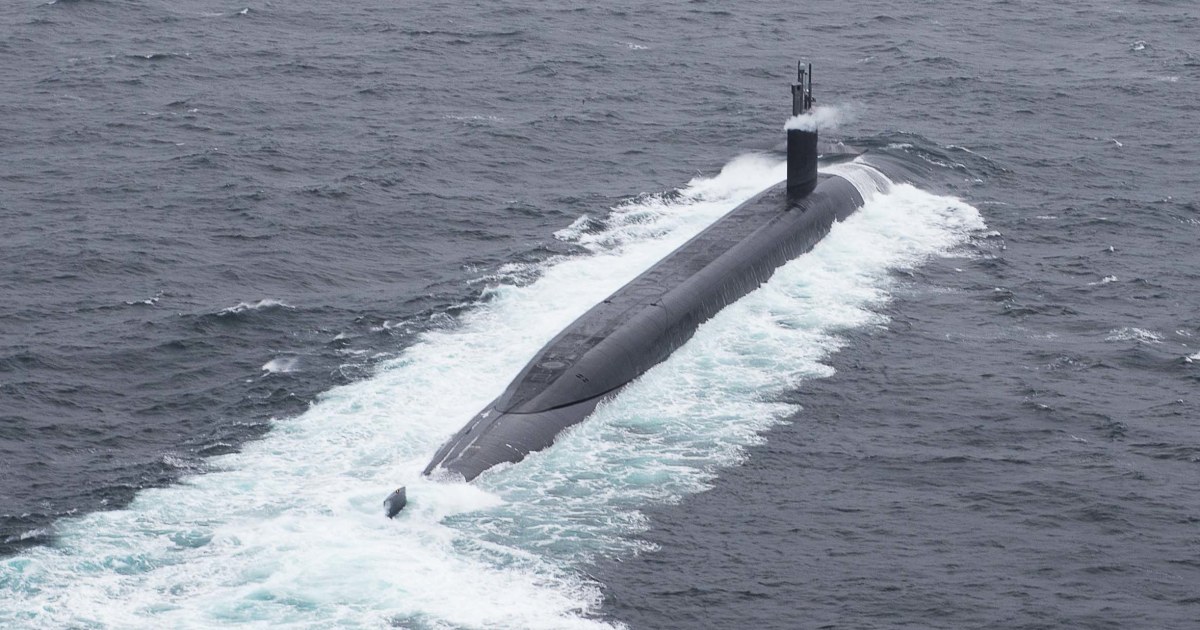
SEOUL, South Korea — For the first time since the 1980s, a US nuclear-armed ballistic missile submarine (SSBN) visited South Korea on Tuesday as the allies began talks to coordinate their responses in the event of a nuclear war with North Korea.
White House Indo-Pacific Coordinator Kurt Campbell confirmed the rare visit, which was expected after it was announced in a joint statement during a summit between South Korean President Yoon Suk Yeol and President Joe Biden in Washington in April.
“As we speak, a US nuclear submarine is making port in Busan today. That is the first visit by (a) US nuclear submarine in decades,” Campbell told reporters at a briefing in Seoul, where he was attending the first Nuclear Consultative Group (NCG) discussion with South Korean officials.
The group, whose goal is to better coordinate an allied nuclear response in the event of a war with North Korea, was also announced during the April summit amid growing calls in South Korea for its own nuclear weapons, a step it Washington objects.

North Korea, which tested an intercontinental ballistic missile last week, on Monday condemned the NCG for “openly discussing the use of nuclear weapons” and warned against allied plans to increase military shows of force, including a submarine visit.
Campbell did not identify the submarine, but said its visit is a manifestation of the US commitment to defending South Korea.
The South Korean Defense Ministry later confirmed the submarine’s arrival and identified it as the USS Kentucky, an Ohio-class SSBN.
US SSBNs rely on stealth to ensure their survival and preserve their ability to launch nuclear missiles during a war, and they rarely make public stops in foreign ports.
The United States has pledged to deploy more strategic assets such as aircraft carriers, submarines and long-range bombers to South Korea to deter North Korea, which has developed increasingly powerful missiles that can hit targets as far away as the United States.
The US Navy has 14 SSBNs, often referred to as “boomers”. The Ohio-class submarines carry 20 Trident II D5 missiles, each of which can deliver up to eight nuclear warheads to targets up to 7,500 miles away.
There were regular SSBN visits to South Korea in the 1970s, another period when South Korea was debating the strength of the US commitment and the need for its own nuclear arsenal, according to a report by the Federation of American Scientists. .

South Korea’s top deputy national security adviser Kim Tae-hyo, who co-chaired the meeting, said the discussions are enough to ensure that South Korea does not need to develop its own nuclear weapons.
The two sides agreed to facilitate information sharing, including the establishment of a secure communication network, and coordination and planning in the event of a North Korean nuclear attack, which would face an “overwhelming” allied response, Kim said.
The allies will also carry out “operations, exercises, simulations, training and investment activities” to bolster nuclear response and deterrence capabilities on the Korean peninsula, according to a statement issued after the meeting.
Yoon, the South Korean president, said the NCG would be a “starting point” for building a strong and effective deterrent against North Korea.
“Through a US-South Korea alliance upgraded to a new paradigm based on nuclear power, we will make substantial efforts to fundamentally block North Korea’s nuclear and missile threats,” he told a briefing.
China and North Korea have criticized the group’s formation for further escalating tensions on the Korean Peninsula.


