

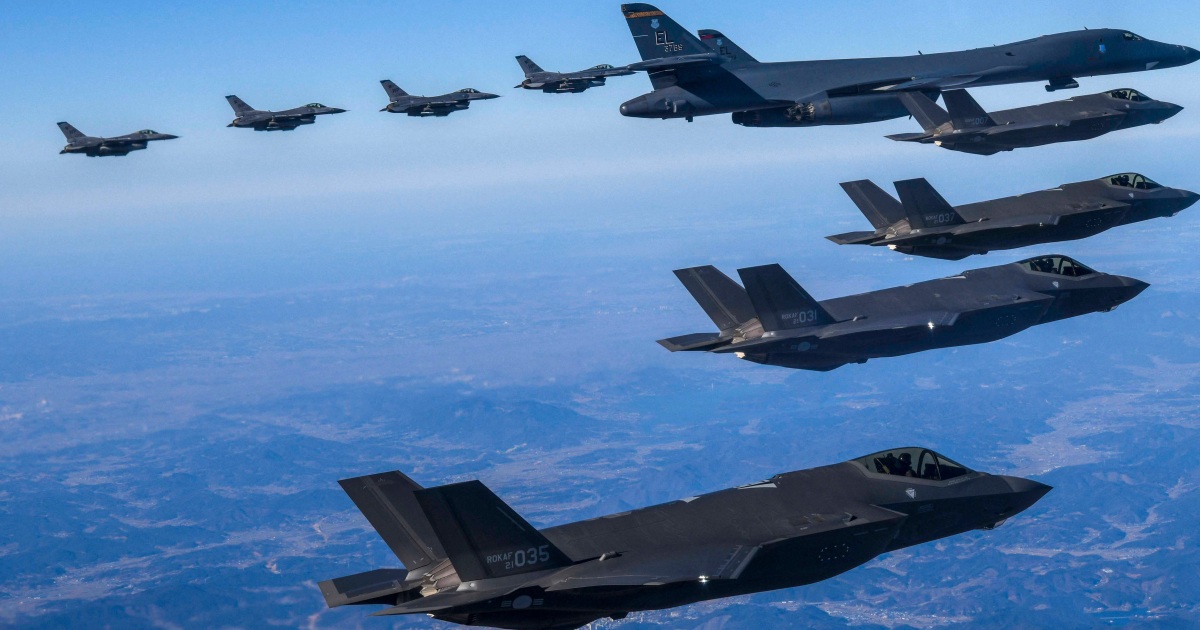
The United States and South Korea conducted a combined aerial drill that included a strategic bomber, the South Korean military said Sunday, a day after North Korea launched an intercontinental ballistic missile in waters off Japan.
South Korean stealth fighters and jets flew alongside US F-16 fighters to escort a B-1B bomber, South Korea’s Chairman of the Joint Chiefs of Staff said in a statement on Sunday.
“The training was aimed at demonstrating the combined defense capabilities of South Korea and the United States and the posture presented by the overwhelming forces of the alliances through the timely and immediate deployment of the extended deterrence assets of the United States in the peninsula of Korea,” the statement added.

Japan also flew F-15s over the Sea of Japan with B-1 and F-16 bombers from the US Armed Forces in tactical exercises, Japan’s Defense Ministry said in a statement, according to Reuters.
The exercises, which were previously planned, came a day after North Korea fired a long-range ballistic missile from its capital, Pyongyang, into waters off Japan.
Calling it a “scandalous act,” Japan’s Prime Minister Fumio Kishida said Saturday his country had “launched a very strong protest” after the missile landed about 125 miles west of Oshima Island in the area exclusive economy of your country.
Confirming the launch on Sunday, North Korea’s state news agency KCNA reported that it had been ordered directly by the country’s leader, Kim Jong Un.
KCNA later released a statement from Kim’s sister, Kim Yo Jong. She quoted her as saying the missile would not target South Korea as “we have no intention of going head-to-head with them yet.”
He added that the United States should “stop all actions that pose threats to the security of our state” and warned of a “very powerful and overwhelming counter against all their hostile moves towards us,” according to KCNA.
North Korea is coming off a record year for weapons demonstrations with more than 70 ballistic missiles fired, including intercontinental ballistic missiles with a potential range to reach the continental United States by 2022.
Saturday’s launch was only Pyongyang’s second in 2023, but it came after a massive military parade in Pyongyang last week saw Kim demonstrate more than a dozen ICBMs.
Yasukazu Hamada, Japan’s defense minister, told reporters that, according to calculations, it could have a range of nearly 8,700 miles, “in which case, the entire United States would be within range.”
Speaking after the launch on Saturday, Secretary of State Antony Blinken said the United States was “prepared to engage with North Korea without preconditions” and that “our commitment to the security of our close allies and partners, South Korea and Japan , it is iron. .”
North Korea has insisted that its testing activities are a warning amid an increased US presence in the region. But some experts worry that Pyongyang will also use the drills as an opportunity to test new weapons, strengthen its nuclear capability and increase its influence in future dealings with Washington and Seoul.
Stella Kim reported from Los Angeles and Leila Sackur from London.
Associated Press contributed.


