


Contents
- thomas sparrow
- BBC World, Washington (@bbc_sparrow)
The Chilean Juan Gabriel Valdés only has to look through the windows of his residence to remember how he was about to die in one of the worst attacks in the history of Washington.
200 meters from where he lives today in the northwest of the US capital, in a roundabout called Sheridan Circle, former Chilean minister Orlando Letelier died on September 21, 1976 when a bomb installed in his car exploded.
At the time, Valdés was a young assistant to Letelier and traveled with him to the office every morning. Every morning except this one.
“I was saved from not going in the car simply because my wife asked me to stay with the children that morning,” he told BBC Mundo Valdés, who returned to Washington a few months ago to take over as Chile’s ambassador to the United States.
It is, by coincidence, the same position that Letelier held more than four decades ago, during the socialist government of Salvador Allende.
“I feel very happy to be back, although I live in a world of memories that are present in almost all the places I’ve been since I’ve been here,” says Valdés.
The unforgettable baggage of the past

image source, Salvador Allende Foundation Archive
Orlando Letelier was an important figure in the government of Salvador Allende, with whom he appears in this 1973 image.
The most obvious place where this unforgettable baggage from the past comes to light -as he himself describes it- is a small monument located under a tree, which not many passers-by notice.
It stands a few steps from his home, in the embassy district, and is inscribed with an image of Letelier and his American aide Ronni Moffitt, who was also killed in the bombing. The monument calls for justice, peace and dignity.
“Every morning I drive by here, I see this and I remember that moment, a very defining moment in my life,” Valdés says as he gazes at the monument.
“It’s not easy to have words to explain emotions and in this case it’s amazing how I can never stop remembering it when I pass by here.”
What Valdés does have words for is to describe his relationship with Letelier, a figure whom he admired and respected to the point of considering him a “hero of a story of resistance.”
The figure of Letelier
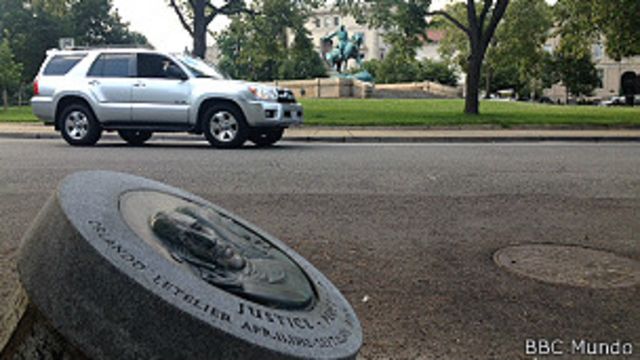
image source, BBC World
In northwestern Washington there is a monument dedicated to Letelier.
Letelier was Allende’s defense minister when he was overthrown by General Augusto Pinochet in 1973.
He was sent to Dawson Island, a detention center in the far south of Chile. After his release, he went into exile in Washington to work at the Center for Political Studies, a left-wing organization.
In the US capital, he stood out as a staunch opponent of Pinochet and met Valdés, who had just finished his doctoral studies at Princeton University and spent his time organizing student campaigns against the Chilean military leader.
In March 1976, six months before the car bombing, they began working together.
Letelier “was a very influential person, but he made only one mistake,” recalls Valdés. “He was convinced that nothing like this could happen to him in Washington.”
But it happened: an investigation by the Federal Bureau of Investigation (FBI) found that the assassination was planned by agents of the Chilean secret police, DINA, under the orders of an American named Michael Townley.
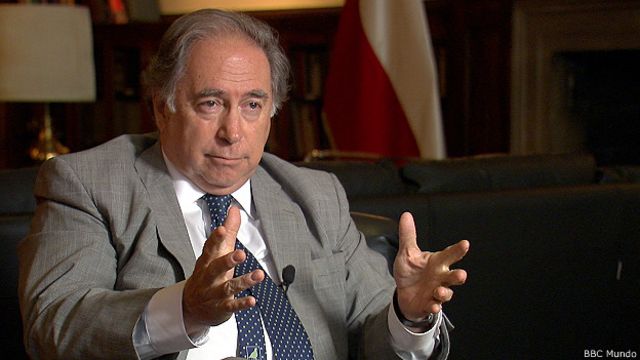
image source, BBC World
Valdés received BBC Mundo at the Chilean embassy in Washington.
“The one who should have been in that car was me”
Almost four decades after the attack, Valdés admits that Letelier’s death had a profound effect on him and marked “the destruction of innocence.”
“It created a situation of proximity to evil that we had never imagined before,” he says. “This, of course, has a very strong impact on a young man and changes his character.”
The ambassador has also faced feelings of guilt and confesses that instead of Ronni Moffitt, “the one who should have been in that car was me, who Orlando picked up every morning.”

image source, Museum of Memory and Human Rights
This is how Letelier’s car was left after the explosion in Washington. (Photo courtesy of the Isabel Morel Fund, Archive Museum of Memory and Human Rights).
“I have not stopped wondering why we did not call the police when we saw that the car had strange expressions: the headlights were on the day before without explanation or the keys were lost without us understanding who had taken them from the office.”
These are questions that lack an answer, but perhaps they have given Valdés an additional boost to publicize his story with Letelier.
On the same day that he presented credentials to US President Barack Obama, in mid-May, Valdés went with his embassy team to the monument at Sheridan Circle, left a flower arrangement and paid tribute to his mentor.
That gesture, he says, marked the return to a very important moment in his life, but he also considers it part of the path that Chile has taken to rebuild its collective memory.
“Here there is a process of wounds that were left open and what one wants is to heal from that brutality that the Pinochet regime meant in the lives of all of us.”
This is how Juan Gabriel Valdés described what was his official return to this city from which he left a few months after the bombing, full of despair and with the goal of restarting his life. He is here today with the aim of not forgetting his past.
image source, BBC World
Valdés took office on May 21 of this year.


