


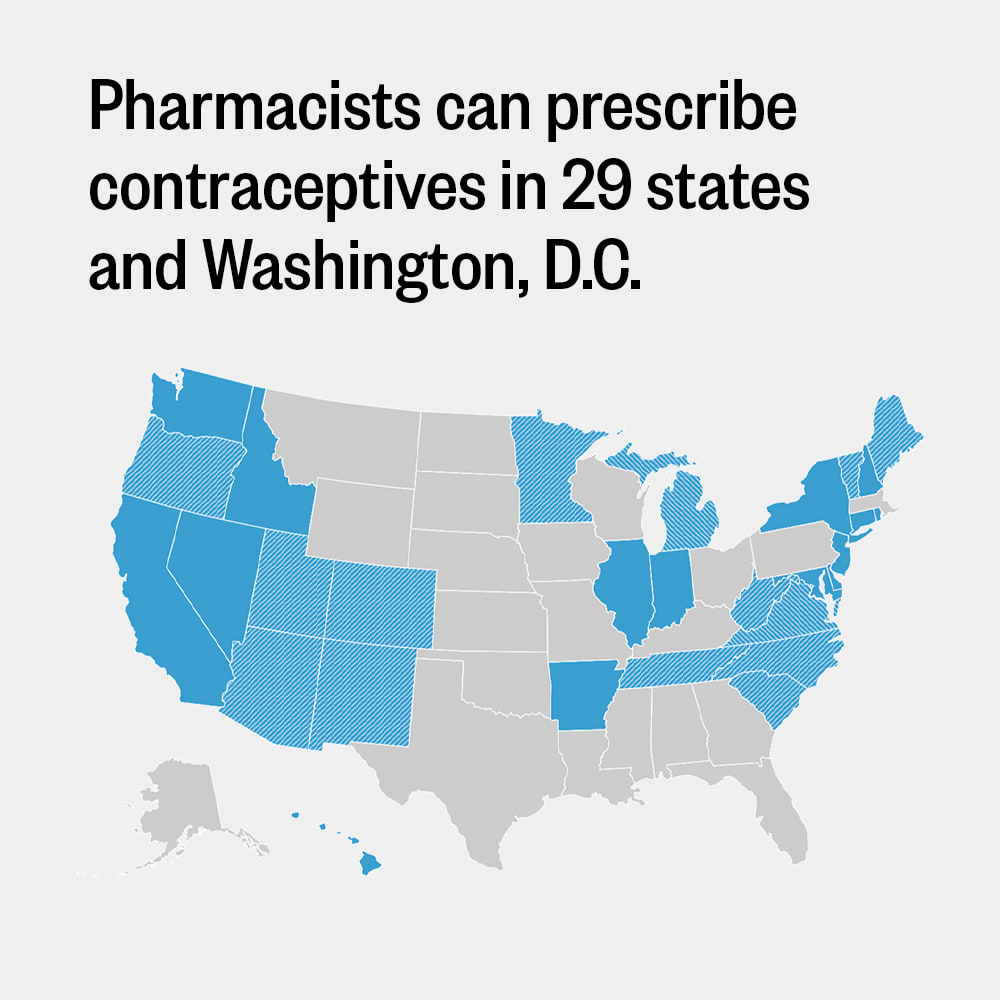
Last week, Arizona became the latest in a growing group of states that allow people to get birth control from a pharmacist without a prescription.
Since 2016, 29 states and Washington, DC, have passed laws allowing pharmacists to prescribe hormonal contraceptives, such as birth control pills and patches. Arizona’s new policy, announced on Thursday, applies to persons over the age of 18 and comes immediately after similar legislation that Rhode Island Gov. Dan McKee, a Democrat, signed the law into law last month.
Policies vary by state: 10 states require patients to be 18 or older, while four specify that pharmacists can only prescribe pill and patch forms. The pill is the most popular form of hormonal birth control: 14% of American women ages 15 to 49 currently use it. according to the Centers for Disease Control and Prevention.
Nicole Huberfeld, co-director of Boston University’s Reproductive Justice Program, said one factor fueling the trend is a shortage of primary care providers.
“Pharmacists became important access points during the covid-19 pandemic,” Huberfeld said. “State laws were out of step with the care that pharmacists can actually provide, and the pandemic highlighted the need to rethink and perhaps modernize how pharmacists can use their license.”
Another factor, he added, is the annulment of Roe v. Wade last year and the increase in abortion restrictions across the country.
“You can’t have fewer abortions and not have more contraceptives,” Huberfeld said. “Those things have to go hand in hand.”
Food and Drug Administration advisers recommended in May that the agency approve the first over-the-counter birth control pill, but the agency has yet to grant approval. In the meantime, Huberfeld said, allowing pharmacists to prescribe birth control may be especially crucial for people who are younger, low-income or uninsured, who are less likely to visit a doctor’s office.
“There are many places in the United States where people live in medically underserved areas, especially rural areas, and they need more access to care,” he said.
Kelly Fine, executive director of the Arizona Pharmacy Association, said that in states that allow pharmacists to prescribe birth control, interested patients typically start by filling out a screening questionnaire. Once a pharmacist determines that she does not have any conditions that prevent her from taking hormonal contraceptives, such as liver disease or breast cancer, she can review birth control options with the patient, based on that state’s particular regulations.
But Fine added that in states that recently passed these policies, some pharmacies may be slow to start providing prescriptions.
“Sometimes these pharmacies take a while to get services up and running. It requires pharmacists to go through training, pharmacies have to develop the proper policy procedures and get all of that in place,” he said.
Fine suggested patients call their pharmacies to find out if they offer birth control prescriptions.
“The whole goal is to make sure that when women decide to get pregnant, they are healthy, ready and wanting to have a baby,” he said.
As another alternative to doctor visits, Planned Parenthood also offers digital prescriptions for birth control via app in 42 states and Washington, DC


