


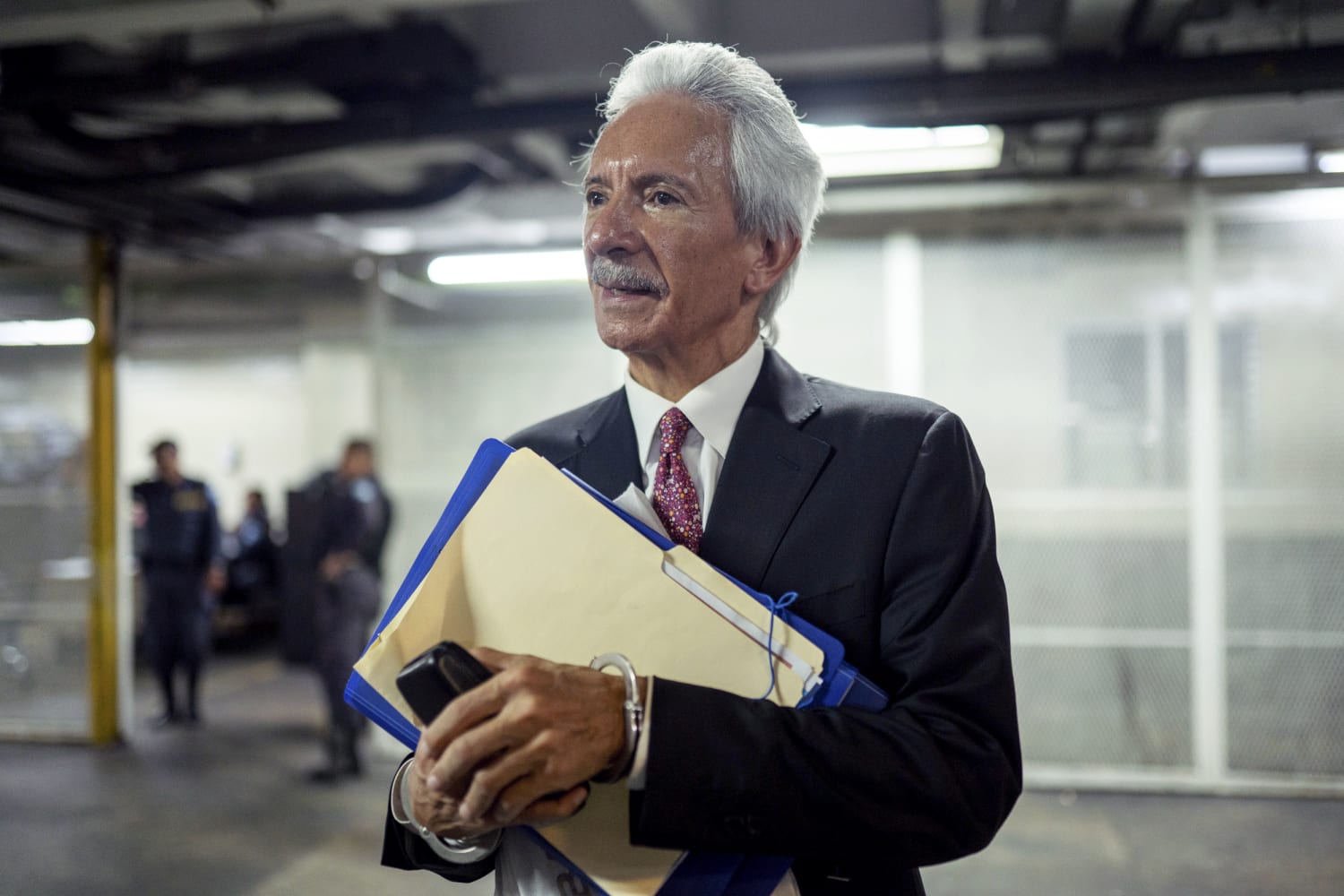
It has been almost a year since prominent Guatemalan journalist José Rubén Zamora, founder of the independent investigative newspaper “El Periódico”, was imprisoned in his homeland in connection with a case denounced by human rights activists and groups as a political persecution that seeks to undermine democracy and freedom of expression.
“The State of Guatemala and more specifically President Alejandro Giammattei has held my father hostage for 343 days,” José Carlos Zamora, a journalist and media executive in the United States, said in Spanish. “He spends 23 hours a day locked up in solitary confinement, with barely an hour of sun.”
Guatemalan authorities arrested José Rubén last July on charges of money laundering, blackmail and influence peddling. The blackmail and influence peddling charges were dismissed during the months-long court battle, but the 66-year-old was sentenced to six years in prison last month in the money laundering case. The sentence was well below the 40-year sentence requested by the Guatemalan Attorney General’s Office.
In conversation with NBC News, José Carlos details how “all my father’s rights were violated” throughout the process, the family’s appeal plan and how his father’s case is connected to Guatemalan presidential elections.
The charges against José Rubén stem from asking a friend to deposit a donation of $38,000 to maintain the newspaper instead of depositing it himself. José Rubén has said that he did it because the donor did not want to be identified supporting “El Periódico” in Giammattei’s sights.
According to the Inter-American Commission on Human RightsJosé Rubén faced “violations of the guarantees of due process, the prolonged use of preventive detention and serious limitations on his right to defense” since his arrest on July 29, 2022. He even went through up to ten different lawyers in nine months due to to harassment and threats.
The court also did not admit evidence or witnesses presented by José Rubén’s lawyer during the trial evidence hearing, the commission concluded. His son said he believes the evidence excluded from the case would have helped his father clear up the remaining money laundering charge he was sentenced on because it “showed where all the money really came from.”
José Carlos said his father’s persecution is the result of decades of honing the tactics of what he calls “the manual of repression,” which has long resulted in harassment, persecution and, in some extreme cases, the murder of journalists who work to uncover irregularities and government corruption.
In more recent years, Guatemala has harnessed the power of government offices, such as the local treasury department, to attack the credibility of news organizations and journalists through “fiscal terrorism,” José Carlos, who also works as Director of Communications at Content of exile, saying. “It’s effective because it requires months of investigation by auditors and ultimately serves to distract you from what you’re working on.”
José Rubén has overseen dozens of corruption investigations during his leadership at El Periódico since the newspaper was founded in 1996, leaving him and his family vulnerable to government-led smear campaigns, car explosions, illegal raids, kidnappingsdeath threats and assassination attempts.
That did not stop José Rubén from publishing stories in 2020 pointing to 144 cases of corruption during Giammattei’s presidency. first 144 weeks in the office.
Some of the most scandalous involved corruption in the purchase of vaccines against Covid-19 and bribery of Guatemalan officials doing business with Russian minerssaid Jose Carlos. “These investigations ultimately cause the state to fabricate a case against my father.”
Since then, the attacks on José Rubén and El Periódico have been so ferocious that the newspaper was forced to shut down its print edition in December and its online operation earlier this year, José Carlos said.
Shutting down the newspaper was one of the goals the Guatemalan government was seeking to achieve, in addition to punishing his father for denouncing the Giammattei regime, José Carlos said.
“They also wanted to send a message to all Guatemalan journalists,” he said. “If they can go after my father, they can go after any of them. That is ultimately a very strong message and an attack that is getting stronger.”
As of last month, at least 20 journalists have been forced to flee the country in recent years, according to the Guatemalan Association of Journalists.
For José Carlos, this “has been a very open political persecution of press freedom that has deprived Guatemalans of being well informed and demanding to have worthy leaders.”
José Carlos believes the Guatemalan government was quick to convict his father just before the first round of voting in the June 25 presidential election, as Giammatei and his administration “have been losing power” at a time when his system of justice has been criticized for going backwards in democratic principles. and arming prosecutors and courts to go after perceived enemies.
Rafael Curruchiche, the prosecutor in the José Rubén case, is even on the US State Department’s list of “Corrupt and Undemocratic Actors.“
Although the US and the leaders of other democratic nations have criticized the Guatemalan government in relation to the case of José Rubén, José Carlos believes that more can be done than is possible, such as direct sanctions against these individuals and the nation.
Given that the US and Guatemala have been looking to work together to curb immigration to the US-Mexico border, the fact that the US is not tougher on the country’s undemocratic issues sends messages contradictory to the Guatemalan government, said José Carlos.
“Corruption has been robbing Guatemalans of their hope and driving them to migrate,” he said, adding that while both countries can invest in a military to stop migration, it still doesn’t solve the core problem that drives people out of his homeland.
As José Rubén’s family plans to appeal the case based on due process violations, José Carlos is optimistic that a new regime will not harm his father’s chance for freedom.
“I don’t think the next administration wants to inherit this,” he said, adding that the new candidates have worked to position themselves as the solution to restoring Guatemala’s eroded democracy.
If the evidence and testimony excluded from the previous trial are included in the appeal, the case against his father “will collapse,” said José Carlos. He expects this to happen in a Guatemalan court. If not, the family is ready to go to the international court.
“He is innocent,” José Carlos said of his father. “This case was fabricated and will eventually be cleared and released.”


