

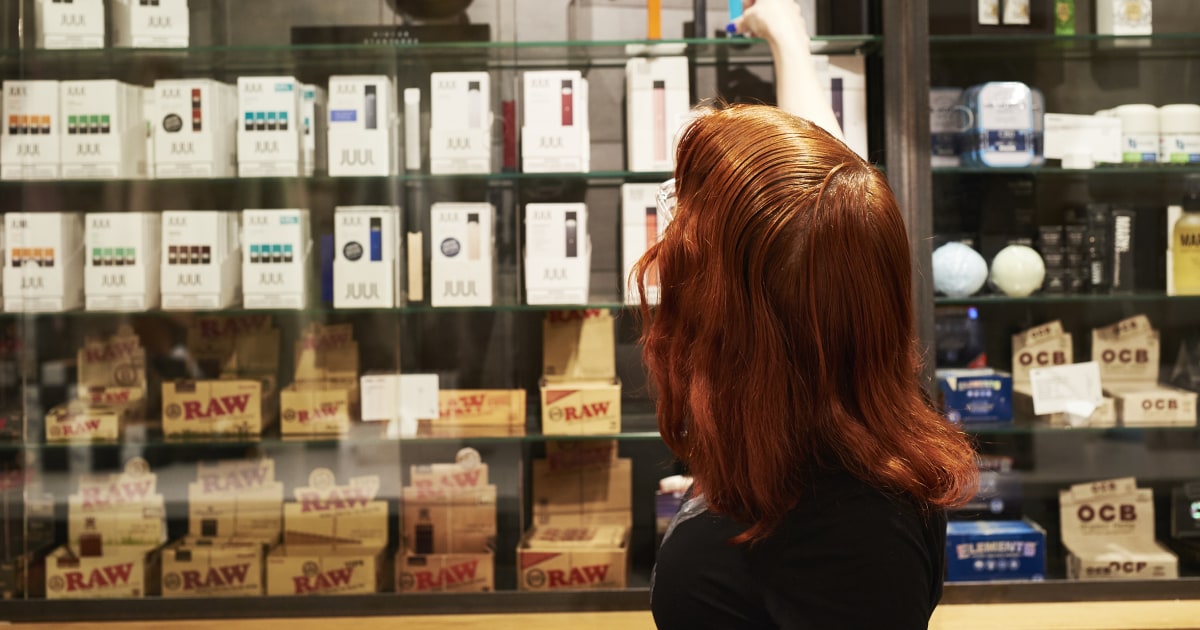

When the FDA first asserted the authority to regulate e-cigarettes in 2016, many people assumed the agency would quickly phase out vapes with flavors like cotton candy, gummy bears, and Froot Loops that appeal to kids.
Instead, the FDA allowed all e-cigarettes already on the market to remain while their manufacturers applied for marketing authorization.
Seven years later, vaping has become a $8.2 billion industryand manufacturers are flooding the market with thousands of products, most sold illegally and without FDA permission, that can be far more addictive.
“The FDA has failed to protect public health,” said Eric Lindblom, former senior counsel to the director of the FDA’s Center for Tobacco Products. “It’s a tragedy”.
However, the FDA is not the only entity that has tolerated the sale of vaporizers to children.
Multiple players inside and outside Washington refused to act, tied the agency’s hands, or refused to provide the FDA with the necessary resources. Former Presidents Barack Obama and Donald Trump have stopped the FDA from broadly banning candy-flavored vapes.
Meanwhile, today’s vapes have become “bigger, meaner and cheaper” than older models, said Robin Koval, executive director of the Truth Initiative, a tobacco control advocacy group. The enormous amount of nicotine in electronic cigarettes: even 76% in five years — can make children addicted in a matter of days, Koval said.
E-cigarettes in the US now contain concentrations of nicotine that are, on average, more than twice the level allowed in Canada and Europe. The United States does not set limits on the nicotine content of any tobacco product.
“We’ve never delivered this level of nicotine before,” said Matthew Myers, president of the Campaign for Tobacco-Free Kids, which opposes vaping among youth. “We really I don’t know long term health transcendence.”
Elijah Stone was 19 years old when he tried his first electronic cigarette at a party. He was a college freshman, dealing with depression and attention deficit hyperactivity disorder, and “looking for an escape.” Store clerks never asked for his identification.
Stone said he was “instantly hooked”.
“The moment I felt that buzz, how was I supposed to come back after feeling that?” asked Stone, now 23, from Los Angeles.
The e-cigarette industry argues that higher nicotine concentrations can help adults who smoke heavily to switch from combustible cigarettes to vaping products, which are relatively less harmful to them. The FDA has approved high-nicotine, tobacco-flavored e-cigarettes for that purpose, said April Meyers, executive director of the Smoke-Free Alternatives Trade Association.
“The goal is to get people away from combustible products,” said Nicolás Minas Alfaro, executive director of Puff Bar, one of the most popular brands among children last year. However, Alfaro acknowledged: “These products are addictive products; That can’t be hidden.”
Although e-cigarettes do not produce tar, they do contain harmful chemicals, such as nicotine and formaldehyde. The US Surgeon General has warned that vaping poses significant risks, including harm to the heart, lungsand parts of the brain that control attention and learning, as well as an increased risk of addiction to other substances.
More than 2.5 million children used e-cigarettes in 2022including 14% of high school students, according to the Centers for Disease Control and Prevention.
Most US teen vapers start blowing within an hour waking up, according to a survey of e-cigarette users ages 16 to 19 presented at the Society for Nicotine and Tobacco Research in March.
Earning potential, and Lax Enforcement of Vaping Laws – has led to a gold rush. The number of unique vaping products, as measured by their barcodes, quadrupled in just one yearrising from 453 in June 2021 to 2023 in June 2022, according to a Truth Initiative review of US retail sales data.
FDA officials say they have been overwhelmed by the volume of e-cigarette marketing applications — 26 million in all.
“There is not a regulatory agency in the world that has had to deal with volume like that,” said Brian King, who became director of the FDA’s Center for Tobacco Products in July 2022.
The agency has fought to stop e-cigarette makers who continue to sell vapes despite FDA rejection of the products, as well as manufacturers who never bothered to apply for authorization, and counterfeiters hoping to gain the most amount of money possible before being closed.
In 2018, public health groups sued the agency, alleging that the delay in reviewing the applications puts children at risk. Although a court ordered the FDA to finish the work by September 2021, the FDA did not meet that deadline. An estimated 1.2 million people under the age of 21 started vaping over the next year, according to a study published in may in the American Journal of Preventive Medicine.
The FDA recently announced that it has made decisions in 99% of e-cigarette applications, noting that it had rejected millions and authorized 23. All of the authorized products have traditional tobacco flavors and were deemed “appropriate for the protection of public health” because tobacco-flavored products are not popular with children but they provide adult smokers with a less dangerous alternative, King said.
The agency has yet to make final decisions on the most popular products on the market. Those applications are longer and need more careful scientific review, said Mitch Zeller, former director of the FDA’s Center for Tobacco Products.
The FDA said it would not complete the review of the applications by the end of June, as previously forecast, but i would need until the end of the year.
Before the FDA can announce new tobacco policies, it needs the approval of the president, who doesn’t always agree with FDA priorities.
For example, Obama rejected FDA officials’ proposal to ban kid-friendly flavors in 2016.
And in 2020, Trump backtracked on his own plan to recall most flavored vapes. Instead of banning all fruit and mint flavors, the Trump administration banned them only on “cartridge-based” devices like Jul. The flavor ban did not affect vapes without cartridges, such as disposable e-cigarettes.
The result was predictable, Zeller said.
Teenagers changed en masse from Juul to brands unaffected by the ban, including disposable vapes like puff pastry barwho were allowed to continue selling caramel-flavored vapes.
After getting his own warning FDA letter last year, Puff Bar now sells only nicotine-free vapes, Alfaro said.
When the FDA tries bold action, legal challenges often force it to halt or even reverse course.
fda ordered Juul to recall its products from the market in June 2022, for example, but was immediately hit with a lawsuit. The US Court of Appeals for the DC Circuit sided with Juul and issued a temporary stay of the FDA’s order. Within weeks, the FDA announced that it would delay execution of its order due to “scientific issues unique to the JUUL app that warrant further review.”
E-cigarette makers Logic and RJ Reynolds Vapor Co. both sued the fda after the agency ordered them stop selling menthol vaporizers, a popular flavor among teens. In both cases, court-imposed stays halted the FDA orders pending review, and the companies’ menthol products remain on the market.
Luis Pinto, spokesman for parent company Reynolds American, said: “We remain confident in the quality of all Reynolds applications and believe there is ample evidence for the FDA to determine that marketing of these products is appropriate for public health protection. .”
Under the Biden administration, the FDA has begun to step up enforcement efforts. He fined 10 e-cigarette manufacturers more than $19,000 each, and has issued more than 1,500 warning letters to manufacturers. The FDA also issued warnings to 120,000 retailers for selling illegal products or selling to customers under the age of 21, King said. Five of the companies that received warning letters they made vaporizers decorated with cartoon characters, like Minions, or shaped like toys, like Nintendo Game Boys or walkie-talkies.
In May, the FDA placed Elfbar and other unauthorized vaporizers from China on its “red list,” allowing fda agents to stop shipments No inspection at the border.
In October, the Department of Justice for the first time lawsuits filed against six e-cigarette manufacturers on behalf of the FDA, seeking to “stop the illegal manufacture and sale of unauthorized vaping products.”
Some lawmakers say the Justice Department should play a bigger role in prosecuting companies that sell kid-friendly e-cigarettes.
“Make no mistake: there are more than six unauthorized e-cigarette manufacturers on the market,” Sen. Dick Durbin (D-Ill.) said in a statement. March letter. Kids are “vaping with unauthorized products that are on store shelves just because the FDA has apparently given these illegal e-cigarettes a free pass.”
KFF Health Newsformerly known as Kaiser Health News (KHN), is a national newsroom that produces detailed journalism on health issues and is one of the central operating programs of KFF — The independent source for health policy research, surveys and journalism.


