

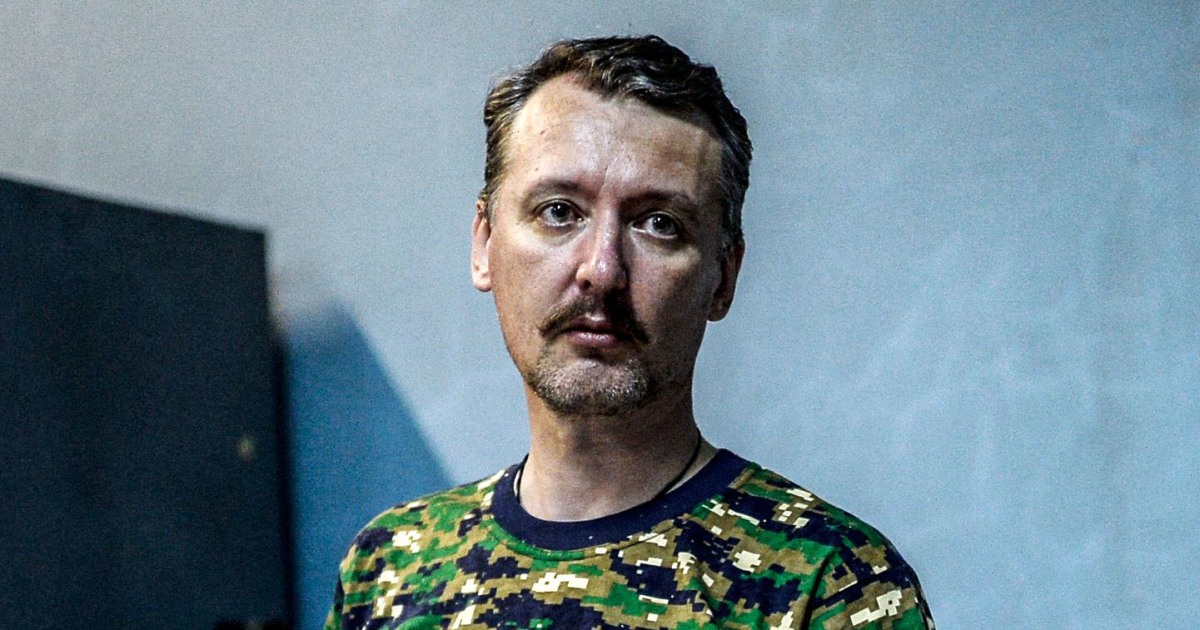
A prominent hardline Russian who accused President Vladimir Putin of weakness and indecisiveness in Ukraine was detained on Friday on charges of extremism, a sign the Kremlin has toughened its approach with hardline critics after last month’s failed rebellion by the Wagner mercenary company.
Igor Strelkov, a retired security officer who led Moscow-backed separatists in eastern Ukraine in 2014 and who was also implicated by the Netherlands in the downing of a Malaysia Airlines passenger plane that year, has argued that full mobilization is needed for Russia to achieve victory and recently slammed Putin as a “never.”
The arrest of 52-year-old Strelkov, whose real name is Igor Girkin, was denounced by his wife, who posted the news on her messaging app channel. She said that she apparently faces charges of extremism.

The move comes nearly a month after a short-lived mutiny launched by mercenary boss Yevgeny Prigozhin in which his Wagner troops captured the military headquarters in the southern city of Rostov-on-Don and then moved 200 kilometers (125 miles) to Moscow to demand the ouster of Russia’s top military leaders. Prigozhin agreed to end the rebellion on June 23 and 24 under an agreement that offered an amnesty for him and his mercenaries and allowed them to move to Belarus.
The revolt posed the most serious threat to Putin’s 23-year rule, eroding his authority and exposing the government’s weakness.
Like Prigozhin, Strelkov harshly criticized Russia’s military leadership for their incompetence, but also denounced Wagner’s boss, describing his action as treason and a great threat to the Russian state. The two had repeatedly traded insults, and Strelkov’s supporters said one of Wagner’s mercenaries launched a criminal investigation into his statements.
Strelkov has more than 875,000 subscribers to his messaging app channel. He served in the Russian army during the Chechen separatist wars and later joined the country’s main internal security agency, the Federal Security Service, where he rose to the rank of colonel.
After retiring from service, he was involved in Moscow’s annexation of the Ukrainian Crimean peninsula and then led fighters in eastern Ukraine during the first months of a Moscow-backed separatist rebellion in 2014.
Last year, a Dutch court convicted him and two other men of murder for their role in shooting down a Malaysia Airlines passenger plane with a Russian surface-to-air missile, killing all 298 people on board the plane as it flew over a separatist-controlled region of eastern Ukraine on July 20, 2014. They were convicted for their role in bringing the Buk air defense missile system from a Russian military base to Ukraine and positioning it for launch. .
Tatiana Stanovaya, a senior fellow at the Carnegie Russia Eurasia Center, said Wagner’s rebellion has given the military an opportunity to go after its critics.
“Strelkov had crossed all imaginable limits long ago, sparking a desire among security forces, from the FSB to military chiefs, to stop him,” he said on Twitter. “This is a direct result of the Prigozhin mutiny: the army command now wields greater political influence to crush its opponents in the public sphere.”
She predicted that while “mass crackdowns against ‘angry patriots’ are unlikely…the most vehement dissidents may be prosecuted, serving as a warning to others.”


