

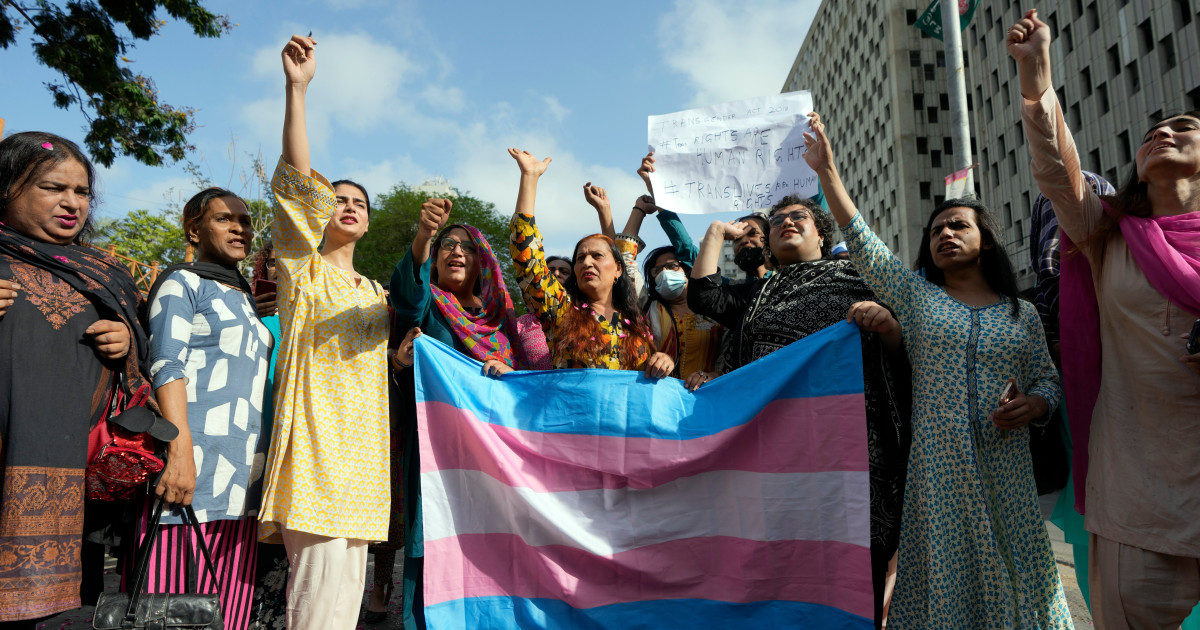
Transgender activists in Pakistan said they plan to appeal to the country’s highest court a ruling by an Islamic court that struck down a law intended to protect their rights.
The Transgender Persons (Protection of Rights) Act was passed by Parliament in 2018 to ensure the fundamental rights of transgender Pakistanis. It guarantees their access to legal gender recognition, among other rights.
Many Pakistanis have entrenched beliefs about gender and sexuality, and transgender people are often considered outcasts. Some are forced to beg, dance and even prostitute themselves to earn money. They also live in fear of attacks.
The Federal Shariat Court struck down several provisions of the landmark law on Friday, calling them “un-Islamic.”
It determined that a person cannot change their gender on the basis of an “inner feeling” or “self-perceived identity” and must conform to the biological sex assigned to them at birth.
The Shariah court is constitutionally mandated to review and determine whether laws passed by Pakistan’s parliament comply with Islamic doctrine.
About a dozen activists protested in the southern port city of Karachi on Saturday against the ruling.

Lawyer Sara Malkani, speaking at an event organized by the Interactive Gender Alliance, denied that the legislation was not Islamic. She said that the existence of two genders does not limit the concept of gender identity and that Islamic texts, including the Quran, do not associate specific behavior with specific genders.
“We fully intend to appeal the court’s findings to the Supreme Court, and we will prevail,” Nayyab Ali, chief executive of Transgender Rights Consultants Pakistan, said at a press conference on Friday.
Ali said the transgender community was “mourning the annihilation” of Pakistan’s first transgender rights protection legislation in response to the Islamic court ruling.
However, clerics and representatives of religious parties say the law has the potential to promote homosexuality in this conservative, Muslim-majority country. They want the Islamic court to strike down the law.
The Shariah court ruled that the term “transgender” as used in the law is confusing. It covers several biological variations, including intersex, transgender men, transgender women, and Khawaja Sira, a commonly used Pakistani term for those who are born male but identify as female.
It also rejected a provision in the law that the country’s national database and registration authority allow the change of a person’s biological gender from the one assigned at birth on identification documents, including driver’s licenses and passports.
He said that allowing anyone to change their gender according to their inner feeling or self-perceived identity will create “serious religious, legal and social problems.”
For example, it will allow a transgender woman, a biologically male person, access to women’s social and religious gatherings or women-only public places, and vice versa, she said.
“This law will pave the way for criminals in society to easily commit crimes such as sexual abuse, sexual assault, and even rape against women masquerading as transgender women,” the court ruled.
However, the court said that Islamic law recognizes the existence of intersex people and eunuchs and said they should have all the fundamental rights granted to Pakistanis in the constitution.
The Pakistan Human Rights Commission expressed dismay at the “regressive ruling” and said the denial of transgender people’s rights to self-perceived gender identity seeks to “erase an entire demographic and their fundamental rights.” He said that reversing the transgender bill will lead to further marginalization and abuse of an already vulnerable community in Pakistan.
Amnesty International called on the government to stop any attempt to prevent transgender people from obtaining official documents that reflect their gender identity without abusive and invasive requirements.
“This verdict is a blow to the rights of the already embattled group of transgender and gender diverse people in Pakistan,” Rehab Mahamoor, a research assistant at Amnesty International, said in a statement.
He said any move to deny transgender and gender diverse people the right to determine their own gender identity would violate international human rights law.
Sana, 40, a eunuch from Rawalpindi who asked to be identified by name, told The Associated Press on Saturday that she was in favor of the court’s ruling because large numbers of gay men were being included in her eunuch community.” original and by birth. .
She alleged that those who become transgender men through surgical castration are “denying the rights” of their community by affecting their access to employment opportunities under the government job quota reserved for their community.


