

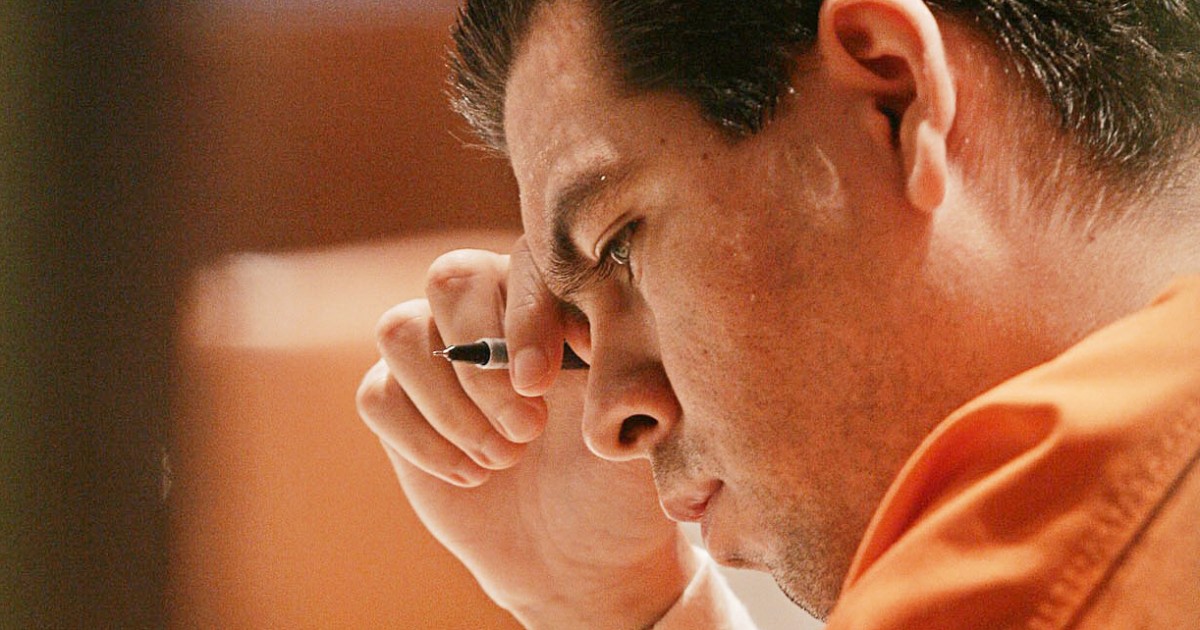
OKLAHOMA CITY — A man scheduled to be executed in September for the 1996 murder of a University of Oklahoma dance student plans to turn down his chance for a clemency hearing, saying there is little hope the state’s Republican governor will pardon him. life.
Anthony Sanchez, 44, said in a telephone interview Thursday from Oklahoma’s death row that even in the rare event that a clemency is recommended by the five-member Board of Pardons and Paroles, Gov. Kevin Stitt is unlikely to grant it.

“I have sat in my cell and watched inmate after inmate get clemency and have clemency denied,” Sanchez said. “Either way, it’s not going well for the inmates.”
Sánchez cited recent cases of Bigler Stouffer and James Coddingtonwho were executed after the board voted 3-2 in favor of clemency, which was later rejected by Stitt.
“They came out and poured their hearts out, man,” Sanchez said. “Why would I want to be a part of something like that, if you’re going to sit there and get these guys excited?”
“Why wouldn’t I try to prove my innocence through the courts?” he added.
Stitt granted clemency to a once convicted inmate, commuting Julius Jones’ 2021 death sentence to life without parole. Jones’ case had drawn the attention of reality star Kim Kardashian and professional athletes with ties to Oklahoma, including NBA stars Russell Westbrook, Blake Griffin and Trae Young, and NFL quarterback Baker Mayfield. They all urged Stitt to commute Jones’ death sentence and spare his life.
Sanchez, who maintains his innocence, said he no longer works with his court-appointed attorneys, but Mark Barrett, who represents Sanchez, said he was appointed by a federal judge.
“If we had been hired and the client didn’t want us anymore, that would be the end of it,” Barrett said. “When there is an appointment, the judge has to release you from your appointment.”
The Oklahoma Court of Criminal Appeals in April rejected a request from Sánchez’s lawyers for an evidentiary hearing in which they claimed that Sanchez’s late father, Thomas Glen Sanchez, was the real killer of 21-year-old Juli Busken.
Busken, of Benton, Arkansas, had just completed her last semester at OU when she was abducted on December 20, 1996, from her Norman apartment complex. Her body was found that night. She had been raped and shot in the head.
The murder went unsolved for years until DNA recovered from his clothing linked Anthony Sánchez to the crime. He was convicted of rape and murder and sentenced to death in 2006.
A private investigator hired by an anti-death penalty group argues that DNA evidence may have been tainted and that an inexperienced lab technician miscommunicated the strength of the evidence to a jury.
But former Cleveland County District Attorney Tim Kuykendall said there was other evidence linking Anthony Sanchez to the murder, including ballistic evidence and a shoe print found at the crime scene.
“I know from spending a lot of time on that case, there isn’t a single piece of evidence that points to anyone other than Anthony Sanchez,” Kuykendall said. “I don’t care if a hundred or a thousand people confess to killing Juli Busken.”
Oklahoma resumed execution of the death penalty in 2021ending a six-year moratorium sparked by concerns about his methods of execution.
Oklahoma had one of the busiest death chambers in the country until issues in 2014 and 2015. Richard Glossip was hours from being executed in September 2015, when corrections officers realized they had received the wrong lethal drug. It later emerged that the wrong drug had been used to execute an inmate in January 2015.
The drug mix-ups continued a failed execution in April 2014 in which inmate Clayton Lockett struggled on a stretcher before dying 43 minutes after receiving the lethal injection and after the state prison chief ordered the executioners to stop.


