


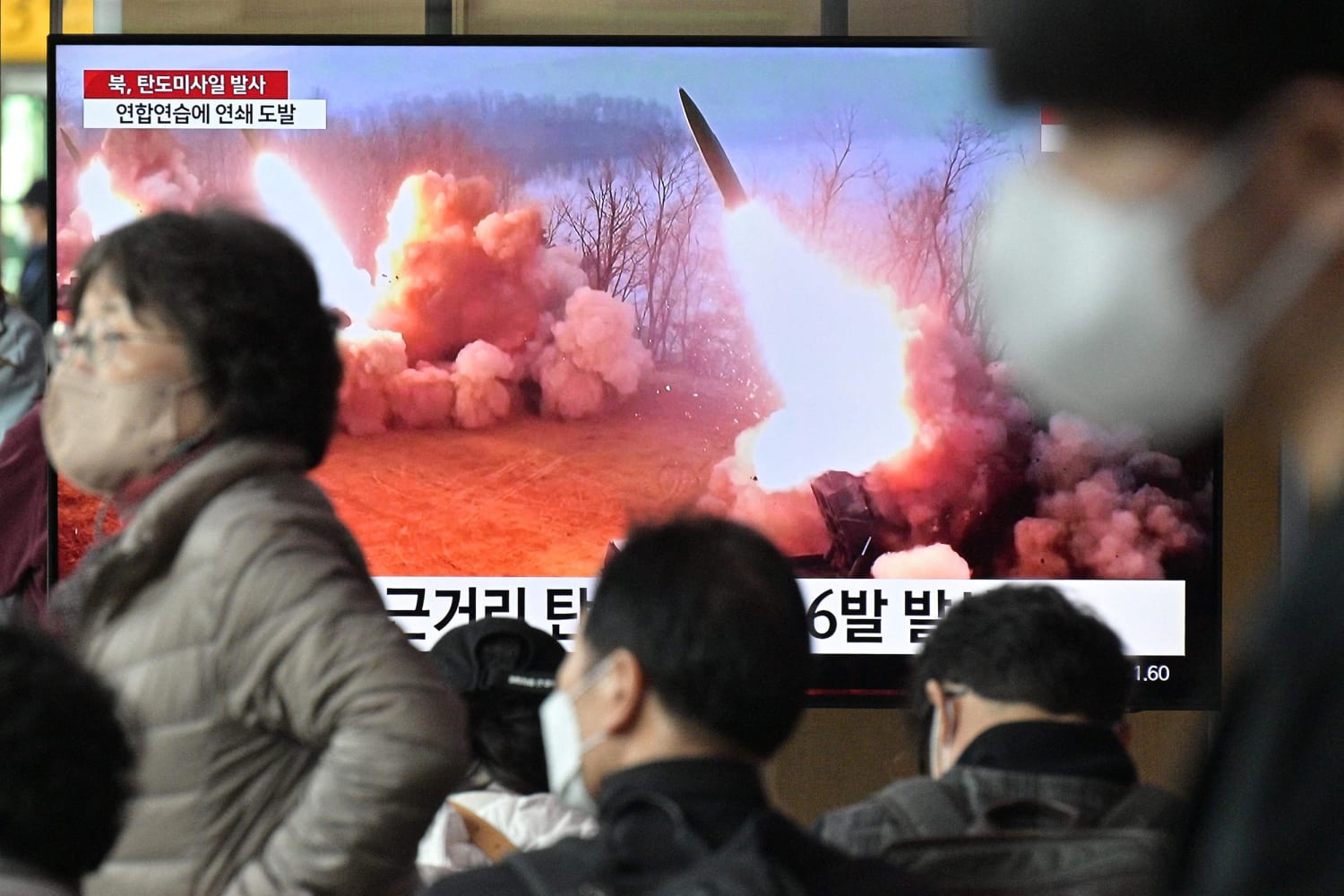
SEOUL, South Korea (AP) — North Korea tested two short-range ballistic missiles Tuesday in another show of force after the United States and South Korea began military exercises that Pyongyang views as an invasion drill, its neighbors said.
The missiles were launched from the southwestern coastal city of Jangyon and flew across North Korea before landing in the sea off the country’s east coast, the South Korean Joint Chiefs of Staff said in a statement. He also said the South Korean military had strengthened its surveillance posture and maintained readiness in close coordination with the United States.
Japanese Prime Minister Fumio Kishida told reporters officials were still gathering details of the North Korean launches and there have been no immediate reports of damage in Japanese waters.
Pyongyang could further intensify its weapons tests in the coming days in a tit-for-tat response to allied military exercises, which are scheduled to run until March 23. Last week, North Korean leader Kim Jong Un ordered his troops to stand ready to repel what he called “frantic moves to prepare for war” by his country’s rivals.
Concerns about North Korea’s nuclear program have risen sharply after North Korea last year tested a barrage of missiles, many of them nuclear-capable missiles, and openly threatened to use them in potential conflicts with the United States and South Korea. South.
North Korea appears to be using the long-stalled talks with the United States and the sprawling US-South Korean drills as an opportunity to increase its stockpiles of weapons to increase its leverage in future dealings with the United States.
Threats from North Korea, coupled with China’s growing assertiveness, have pushed the United States to seek to strengthen its alliances with South Korea and Japan. But some experts say that a solidified cooperation between Washington, Seoul and Tokyo could prompt Pyongyang, Beijing and Moscow to strengthen their own trilateral ties. China and Russia, embroiled in separate confrontations with the US, have repeatedly blocked offers by the US and its allies to tighten UN sanctions against North Korea.
On Monday, North Korea said it had tested two cruise missiles from a submarine. It implied that cruise missiles were being developed to carry nuclear warheads and claimed that the latest test verified the country’s “nuclear war deterrence” stance.
North Korea’s acquisition of submarine-launched missile systems would be an alarming development because the launches would be more difficult to detect and provide the North’s retaliatory second-strike capability. However, experts say it would take years, vast resources and vast technological improvements for the heavily sanctioned nation to build a fleet of submarines that can travel silently and reliably execute attacks.
US national security adviser Jake Sullivan said Monday that North Korea has been honing its submarine launch capabilities since its first test in 2016 and that the US was studying Sunday’s launches to assess what they mean in terms of of the capabilities of the North.
“But, of course, we are not going to allow any steps North Korea takes to deter or limit us from the actions we deem necessary to safeguard stability on the Korean peninsula,” Sullivan said.
The joint US-South Korean exercises that began Monday include computer simulations involving North Korean aggression and other security scenarios and field exercises. The field exercises would return to the scale of the allies’ biggest spring exercises that were last held in 2018, according to South Korean defense officials.
The two countries have been expanding their drills since last year when North Korea tested more than 70 missiles in 2022. Those included intercontinental ballistic missiles with the potential range to reach the continental United States and short-range nuclear-capable missiles that could target South Korea.
In their telephone conversations on Monday, the top nuclear envoys for South Korea and the United States stressed that North Korea would face unspecified consequences for its provocations. They also urged North Korea to abandon its nuclear program and instead care for the livelihood of its people, saying its decades-long preoccupation with nuclear weapons has led to its current economic difficulties and food shortages, according to the Foreign Ministry. from seoul.


