

NEAR DOVHENKE, Ukraine — They don’t fight, they find.
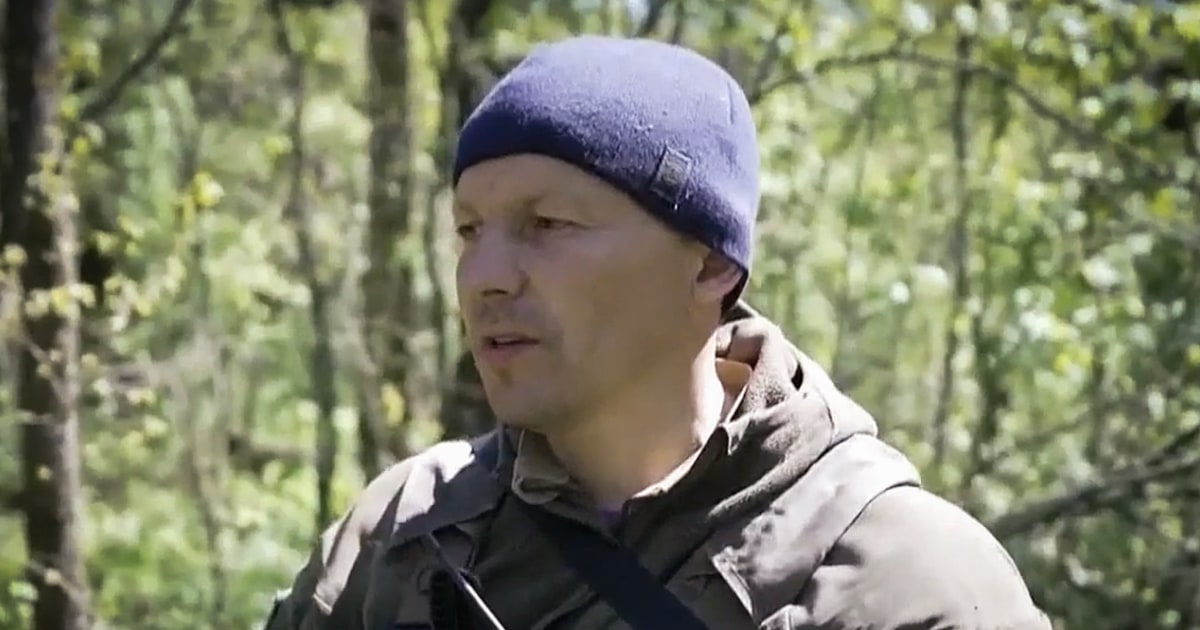
Deep in the forests of eastern Ukraine, leaves green with the new life of spring, the unit known as On the Shield searches for the country’s fallen soldiers.
“Our guys are here somewhere,” team leader “Mykha” told NBC News earlier this month. He asked to be identified only by his call sign in accordance with Ukrainian military protocol.
The team focused their search near the town of Dovhenke, the scene of a brutal Russian attack in April 2022, two months after President Vladimir Putin launched his invasion.
Burnt-out cars and tanks were strewn along parts of the road, and most of the buildings looked as if they’d been hit with a wrecking ball. Pockmarks from artillery covered the few left standing.
At least five soldiers from the Ukrainian 95th Air Assault Brigade defending the area were still missing, Mykha said.
But every day, the team’s eerie quest grows more difficult, as the spring revival has covered clues and made the graves, once easy to spot during the cold, harsh winter, far more difficult to find. find.
As a result, the bodies that remain from that era are “skeletonized,” Mykah said, adding that “any signs, such as tattoos or other markings, are no longer visible.”
However, the soldiers found a military jacket hanging near one of the holes dug by the Ukrainian soldiers to sleep in.
Other things were distinctly Russian, like a “telnyashka,” a blue-and-white striped undershirt traditionally worn by members of the Russian military. Nearby, a bulletproof vest with Russian writing lay on a tree.
Mykha said the unit, which is made up of volunteers rather than conscripts, did not count the number of Russians it had discovered, but “definitely found several hundred.”
“When our troops were advancing, it is clear that the Russian army also left their soldiers behind because they had no opportunity to take them,” he said. “The first groups that arrived picked them up everywhere: on the roads, in the houses.”
Elsewhere along the way, one of the prospectors yelled that he had found bones in a burnt-out tank, one of three. One had the letter “Z” painted on the front, a symbol seen on Russian tanks and military vehicles in Ukraine and embraced by Putin’s war supporters.
Pulling on a pair of blue latex gloves, a seeker climbed into the tank closest to the tree line and another climbed into the turret while Mykha helped prepare a body bag.

“Is it from the leg or where?” the searcher within the wreckage asked as he sifted through the charred wreckage, stopping occasionally to touch what he found on the side of the tank.
Glass and metal sound different from bone, so the team can tell if it’s human remains.
“Maybe there’s nothing to record,” he said, but then realized he was checking out the scene of a tragedy.
“It was burned here,” he said, examining the fragments of what was once a man. “His bones of him are burned.”
For Mykah and the rest of the On the Shield unit, the man’s nationality is not important. Since they are volunteers and not conscripts, their goal is to live up to one of the oldest military mantras: leave no man behind.
“Now we are trying to find everyone, because they are going to be exchanged, and every Russian soldier is practically one of our returning soldiers,” Mykha said.
“In this case, our army is of course the priority,” he said, adding that it was just as important to his team that the relatives of Russian soldiers “seek some peace.”
“We have no choice because we are defending our country, but probably not everyone understands why they came here,” he said.
His task, though grim, allows for closure for the families and friends of the dead.
After Yurii Roslov and his unit went missing on a combat mission in late March 2022, their commander in the 95th Air Assault Brigade, which uses the call sign “Chef,” said he “hoped they would be captured.” but there was no news.” .”
Months later, On the Shield found the 26-year-old’s body buried in a shallow grave near the village of Dovhenke.
Some 400 miles away, in the Ukrainian capital kyiv, Roslov’s family was finally able to bury him on May 6 at the Mis’Ke Kladovyshche cemetery.

As a bugle sounded, his mother wiped away her tears and the priest began to pray.
Burying Yurii was “like ripping out a part of myself,” her commander said. “And then you start living again, somehow, knowing that you won’t see him anymore, that you won’t talk, that you won’t hear his songs, that you won’t hear the sound of that guitar.”
As the last shovel of dirt covers Yurii’s coffin, the music begins again.


