

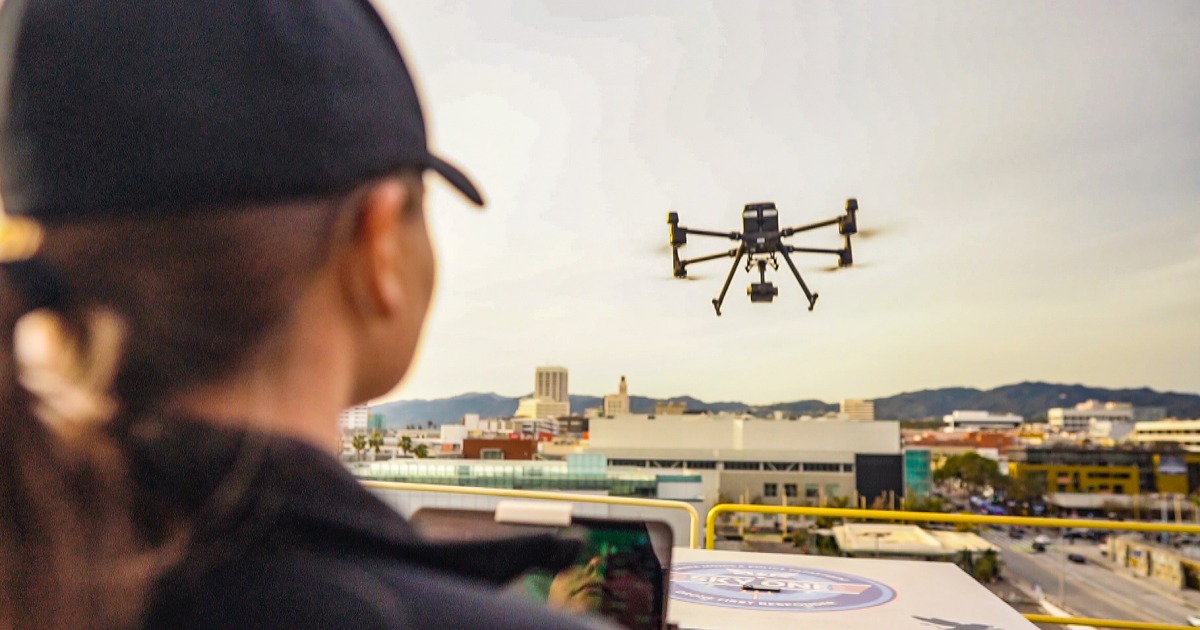
“What we find in tactical situations is if we can get through to one person, we can de-escalate much faster and resolve the situation,” said Don Lemond, a retired Chula Vista police officer who now works for BRINC. “But we also deployed it during the bayside condominium collapse in Florida to look for people who were trapped inside the building.”
Jay Stanley, who has examined the use of government drones as a senior policy analyst for the American Civil Liberties Union in Washington, says his organization is not opposed to deploying drones to respond to emergencies or in hostage situations.
“Our position is that it is legitimate for police departments to use drones to find a missing child in the woods, for raids, for accidents, for crime scenes,” he said.
But police use of drones raises “the same questions that body cameras raise,” he said. “What about the images? Who has access to it? Are the police going to publish the images when it makes them look heroic and bury them when it doesn’t?
Police have tried to address those concerns. The departments prohibit operators from recording video over private homes or other places where people have a reasonable expectation of privacy, except in emergencies or pursuant to court orders. Chula Vista publishes the flight paths of each drone mission on its website. Santa Monica officials say they destroy all videos after 60 days unless they are used as evidence or needed for an investigation.
Police say they have informally shown the drone’s camera video to anyone who expresses concern, though California departments have taken the position that the video cannot be released under public records laws. That premise is being questioned in a lawsuit against Chula Vista by La Prensa San Diego, a bilingual Latino newspaper.
A lingering eye in the sky could give police a big boost in solving street crimes, particularly in neighborhoods where witnesses tend to be uncooperative. But it would also give the government terabytes of data on everyone’s movements, and the courts have so far deemed that an unacceptable invasion of privacy.

In 2021, a program was launched in Baltimore in which police conducted persistent aerial surveillance using cameras mounted on aircraft. declared unconstitutional by a federal appeals court, which said it violated the Fourth Amendment protection against unreasonable searches and seizures.
The 8-7 decision drew strong dissent from the minority, which said the harm from the crime outweighed potential privacy concerns. By then, the Baltimore show had already ended, so the case never made it to the Supreme Court.
Drones responding to emergency calls don’t raise the same constitutional concerns, experts say. The biggest benefit is “situational awareness,” Lashley said. “It allows an experienced police officer to see what’s going on in real time and communicate those facts to responding officers and give them that perspective of what to expect, rather than just going in with information from a phone call.”
In Chula Vista, drone operators listen to 911 calls and can dispatch their aircraft based on information obtained during the calls, even before police are dispatched, authorities said.

Often the greatest beneficiary is the target of a police encounter. Last year, Santa Monica received a 911 call about a man with a gun in a pharmacy parking lot. As officers sped to the scene, the drone flew overhead and at first appeared to confirm the man had a firearm.
But moments later, Lashley said while showing the video to NBC News: “I can see clearly, and you’ll see him exhale, there’s a little bit of smoke in here in a second, which I’m 99% sure that’s something.” type of lighter.”
That allowed a foot officer to approach the man without concern that his life was in danger, which changed the nature of the encounter. A similar situation played out in Santa Monica when a group of teenagers appeared to be passing two handguns around in a main beachfront shopping area, as seen in the drone video.
“The drone got there,” Lashley said. “We identified that, indeed, they had weapons, [but] as we watched them, we determined that those weapons were actually BB air pistols. We were able to communicate that. It de-escalated the situation and it went from being a violent crime in progress to… a bunch of teenagers going around antics.”
Some of the worst incidents of police violence in recent years “were the result of police going into a situation with limited information,” said Santa Monica Mayor Gleam Davis, a Democrat who once worked in the Rights Division. Justice Department Civilians. “The drone really allows us to make a much better assessment of the situation on the ground.”
Police drone advocates often cite the example of 12-year-old Tamir Rice, who was shot and killed by Cleveland police in 2014 after he was seen playing with a pellet gun. An overhead drone might have allowed responding officers to understand it was not a threat, they say.
Police in Chula Vista and Santa Monica say they have used drones to look through the front windshields of vehicles during traffic stops, reducing the chances of overreactions from officers approaching from behind with limited visibility.
Fire departments also have access to drones that respond to 911 calls and have used them to better understand fires and spills involving hazardous materials.
According to data from drone manufacturer DJI, more than 1,000 people in 39 countries have been rescued from danger by drones. DJI lists salvages from around the world in the DJI Drone Rescue Mapwhich tracks more than 600 incidents in which drones have been used by police, firefighters, rescue teams and bystanders to save people from danger since the first known rescue in 2013.
But DJI, the leading brand of commercial and consumer drones, is itself a thorny issue. The Defense Department blacklisted DJI, a Chinese-owned company, last fall as a “potential threat to national security” amid concerns that drone data could be shared with the Chinese government. DJI denies that it poses a threat.

The United States has not prohibited state and local governments from using DJI drones.
“We absolutely appreciate as best we can that there are national security concerns,” Lashley said, but “we don’t have any military bases. We don’t have, as far as I know, any secret places in Santa Monica.
Drones often give police more time to make decisions, and time can save lives, Redondo Police Capt. Stephen Sprengel said.
“It’s an incredible resource that will potentially reduce risk and liability and ultimately make policing safer for not only the community but also the officer,” he said. “It’s amazing what you can see from the air.”


