

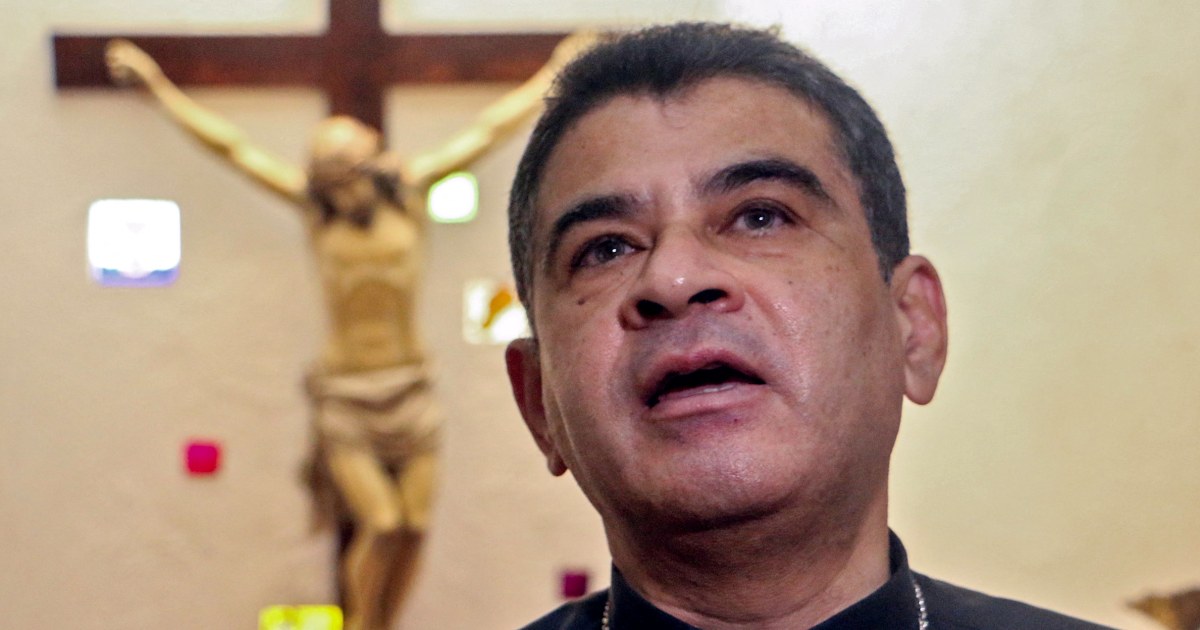
MIAMI — Supporters of Nicaraguan Catholic Bishop Rolando Álvarez back him, saying they are not surprised refused to leave his country and instead chose to remain in prison.
“I was not very surprised by his response because that is Rolando, a man who is firm in his decisions,” said a Nicaraguan priest in exile in Miami, who requested anonymity for fear of reprisals against his relatives in Nicaragua.
One day after a flight went to the United States with 222 opponents of the increasingly authoritarian leftist President Daniel Ortega, Álvarez, who had been under house arrest, was taken to La Modelo prison near Managua, the country’s capital.
The outspoken government critic was sentenced to 26 years in prison and stripped of his Nicaraguan citizenship. He was charged with treason, undermining the national integrity and spreading false news, among other charges.
Álvarez, 56, is bishop of the diocese of Matagalpa, about 80 miles north of Managua.
He was one of the most vocal religious figures in Nicaragua and had been a key voice in discussions about the future of the country since 2018, when anti-government protests ended in a brutal crackdown by the Ortega regime.
In Miami, the exiled priest who spoke to NBC News said he and Álvarez had attended seminary together in Nicaragua and then in Rome.
“Since he was young he was very tenacious and intelligent. He was a person of conviction and very sure of what he wanted and of his goals —no wonder he didn’t give in (he didn’t give in), said the exiled priest. “I am sure that Rolando has not experienced fear because he knows that what he is doing is correct.”
Ortega said that sudden decision to release 222 political prisoners and putting them on a plane to Washington, DC, was the idea of his wife, Vice President Rosario Murillo.
The couple called the prisoners “terrorists” who were sponsored by the US government and were trying to destabilize their regime.
Political prisoners included priests, political leaders, students, and activists. Like Álvarez, they were stripped of their Nicaraguan citizenship, a move that has drawn international condemnation. Another 94 political opponents had their citizenship revoked on Wednesday.

Ortega described Álvarez’s refusal to board the flight as “an absurd thing.”
Ortega, a former Marxist guerrilla, has had a strained relationship with the Catholic Church. The church is one of the last independent institutions trusted by many in Nicaragua, a country whose people are deeply Catholic.
In recent years, Ortega’s attacks against the Catholic Church have intensified. Last year, the papal nuncio, the Vatican’s top diplomat, was expelled. The government seized several radio stations owned by the diocese in Matagalpa. Álvarez and several other priests and laity had previously been arrested in August.
“The war against the church, against the priests has intensified and terrible injustices are being committed,” said the exiled priest in Miami.
Pope Francis spoke about the situation in Nicaragua and expressed concern during his traditional Sunday blessing on February 12.
“The news that came from Nicaragua has saddened me not a little,” he told those gathered in St. Peter’s Square in Rome, and called for prayers that the political leaders “open their hearts.”
‘Worse and worse by the minute’
In Miami, Nicaraguans are concerned about the deteriorating human rights situation and the imprisonment of Álvarez.
“He has always been humble, simple, intelligent and a person of great faith, devoted to God and his people,” said Muñeca Fuentes, a Nicaraguan activist and Miami resident who knows of Álvarez from his frequent trips to Nicaragua until 2018, when the authorities repressed the protesters.
He said the situation in his home country is “getting worse by the minute.”
“They run Nicaragua as if it were their own private farm and the people their servants,” Fuentes said.
The number of Nicaraguans fleeing their country and arriving at the US-Mexico border has increase in recent years. They are now part of a probation program. the Biden administration was launched in January.
The United States has called for Álvarez’s release.
In an emailed statement, a State Department spokesperson said: “The United States and members of the international community have taken steps to promote accountability for the actions of the Ortega-Murillo regime and will continue to do so. We ask for the immediate and unconditional release of Bishop Álvarez”.
The statement went on to say that “the United States, along with our allies and partners, believes that a return to democracy and respect for human rights and fundamental freedoms in Nicaragua is essential. We will use the diplomatic and economic tools available to promote the accountability of the Ortega-Murillo regime, reiterate our call for the immediate and unconditional release of political prisoners, and urge the restoration of civic space for the people of Nicaragua.”


