

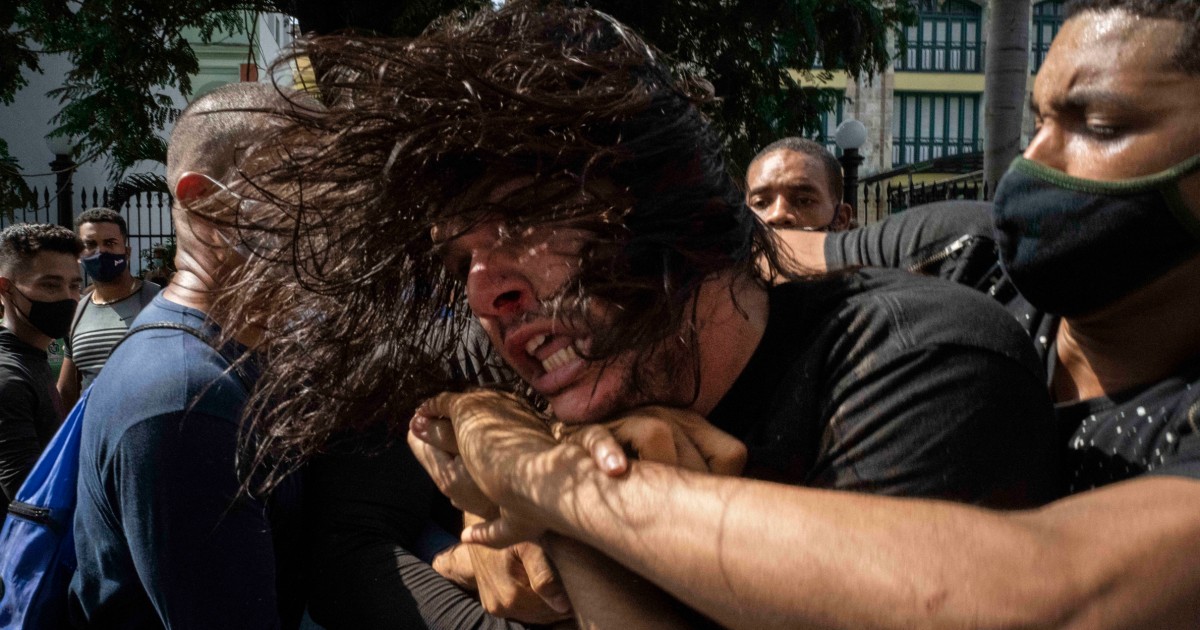

Two years after historic protests against communist rule rocked Cuba, not much has changed.
Huge street protests, often referred to on social media as 11J, after the Spanish date of July 11, led to a harsh crackdown and the arrest of more than 1,500 protesters. Around 682 remain incarcerated, according to the human rights group Justice 11J. The Cuban government puts the number significantly lower, at 488.
Some of Cuba’s leading activists remain behind bars. Before the second anniversary, the Miami Herald published a letter written by the artist Luis Manuel Otero Alcántara, 34, entitled “The Cuban authorities have stolen my youth just for saying what I think,” which details the harsh prison conditions to which he says he has been subjected.
“Today every young Cuban is a political prisoner. A censored artist. An exile inside and outside of Cuba,” Alcántara wrote. “Even if you are an accomplice of the system, you will inevitably be crushed like the others, because being young is being daring and reckless, wanting to change the world. It means fighting for love, dreams and utopia. But these qualities are considered crimes in Cuba, and that condemns us all to martyrdom.”
Alcántara went on a hunger and thirst strike on June 6 and no one has heard from him since, according to Claudia Genlui, a Cuban activist and friend of Alcántara’s.
Manuel Cuesta Morúa, leader of the Council for the Democratic Transition in Cuba, a dissident group, told NBC News that after the protests of July 11, 2021, there was a change in the country with a merger of calls for better economic conditions. and more freedom.
“After July 11, there was a unification of the demands for a better life with the demands for freedom,” said Cuesta Morúa. “And I think that will remain forever in Cuban society.”
“I think the government is trying to teach a lesson because releasing the prisoners immediately could be interpreted, from the government’s point of view, as a weakness,” Morúa said.
There have been sporadic protests in isolated areas across the island since July 11, 2021, but nothing compared to the demonstrations that took place two summers ago.
Other prominent dissidents, such as José Daniel Ferrer and Félix Navarro, also remain in prison.
Guillermo “Coco” Fariñas Hernández, who won the prestigious Andrei Sakharov Prize for Freedom of Thought in 2010, has been on a hunger strike at his home since June 26 to protest against the government and for the release of political prisoners.
The United States, the European Union, the Vatican and human rights organizations, inside and outside Cuba, have called for the release of all political prisoners.
The dire economic conditions on the island that led many to protest two years ago, including inflation and shortages of food, medicine, electricity and gasoline, have not changed. More than 340,000 Cubans have arrived in the US via the US-Mexico border since fiscal year 2022 began. Prominent activists have also fled, saying they were forced to choose between prison or exile. .
Cuba’s government lifted a ban on private companies in June 2021 that had been in place since the 1959 revolution. Until now, about 7,000 companies They have opened. Now they represent 14% of employed people in Cuba.
A editorial In the state newspaper Granma, he accused the US government of being behind the demonstrations. They said the United States incited the protests by providing funds for breaking the law, including robbery and assault.
“The United States bears direct responsibility for the riots of July 11 and 12, 2021,” the editorial said.
The United States denies the claims.
“As everyone knows, the Cuban people protested on their own,” a State Department spokesperson told NBC News.
“As respected NGOs continue to report and document, the regime continues to violently suppress virtually any type of peaceful public dissent and detains, harasses and threatens the families of detained protesters who dare to speak publicly about their detained relatives,” the statement said. spokesperson in a statement. statement by email.
The Cuban government did not respond to a request for comment.
After then-President Donald Trump tightened the screws on the decades-long embargo, the Biden administration eased some sanctions on travel and remittances to the island. But US-Cuban relations remain tense, with Cuba blaming existing US sanctions for most of its economic woes.
Meanwhile, Cuba has signed multiple deals with Russia to boost sugar and rum production, supply wheat and crude oil and repair dilapidated tourist facilities. He The White House recently said that China was going to build a spy facility in Cuba.
In Miami, the heart of the Cuban exile community, a group of Republican and Democratic members of Congress celebrated the anniversary of the protests by calling for tougher sanctions against the Cuban government, citing strengthening ties with Russia and China.
House Foreign Affairs Committee Chairman Michael McCaul, R-Texas, led a discussion that also included activists.
In Hialeah, a working-class suburb, a ceremony was held to name part of a street after “Patria y Vida,” a protest song written by a group of Cuban musicians that became a symbol of the protests. against the Cuban government. One of the musicians, Maykel Castillo, remains in prison.
Morúa says that his dissident group is opting to pressure the Cuban government for legal and constitutional changes.
“I think that it is the only present alternative to achieve these changes, of course with international visibility and support,” he said.
Carmen Sesin reported from Miami and Orlando Matos from Havana.


