

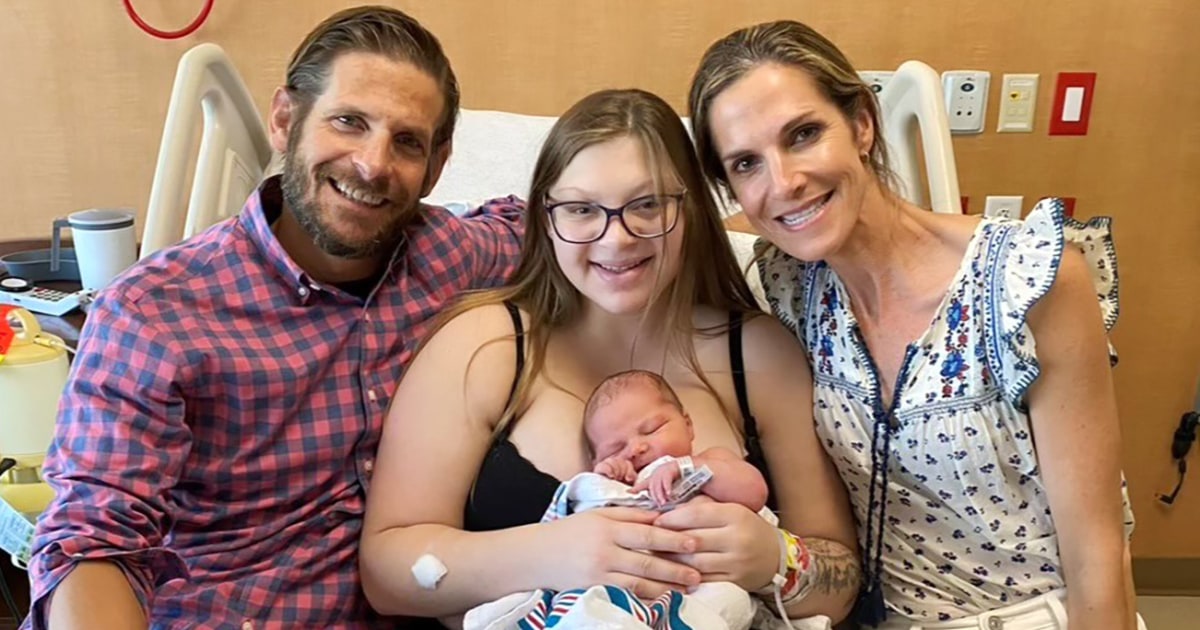
Madelynn Ballenger found out she was pregnant for the second time at age 20. As a single mother of a young son, she didn’t know if she could take care of a second child physically or financially.
“It was really scary,” Ballenger said. “I didn’t have a job. I was not in a good position to expect another child.”
It was September 2021, the month Texas’ ban on abortions after six weeks went into effect, and Ballenger was five weeks pregnant. That left her little time to decide whether to keep the baby or terminate the pregnancy, if she could find an available abortion appointment.
“I was already so stressed and I thought, how am I supposed to make this decision in such a short time?” Ballenger said. “How am I supposed to know what’s good for me, what’s good for my whole situation, in just a few days? No woman should be forced to make that kind of decision in less than two weeks. That’s just not human.”
She opted to carry the baby to term. Then, 48 hours after giving birth to a healthy boy, Ballenger made the agonizing decision to place him in foster care.
“It was the hardest thing I’ve ever done,” he said. “It’s the hardest thing I’ll ever do.”

For years, anti-abortion activists argued that quashing Roe v. Wade would lead more women with unwanted pregnancies to resort to adoption. “Adoption! Not abortion!” was a common message featured on billboards and sung through megaphones at anti-abortion rallies.But more than a year after the Supreme Court’s Dobbs decision, its impact on the adoption landscape is proving multifaceted and difficult to measure. .
Some adoption agencies are seeing significant increases in the number of babies placed in foster care, while others say it’s still too early to tell what role Dobbs is playing.
Kristen Hamilton, director of communications for the nonprofit National Adoption Council, one of the nation’s largest networks of adoption professionals, said the group has seen “a lot of variation” among adoption agencies in states with laws strict on abortion.
“In some cases, they’re seeing an increase in the number of babies being put up for adoption, while in other cases, things have stayed relatively the same as they were before the Dobbs decision,” Hamilton said.
Mark Melson, president and CEO of the Texas-based Gladney Center for Adoption, which facilitates adoptions across the country, said the center has seen a 30% increase in home adoptions of babies in the past year. Meanwhile, inquiries from pregnant women calling to learn about their adoption options are up 55%, he said.

Melson said the trend may be partly due to a decline in Covid rates and restrictions, but he believes the Dobbs ruling has played a key role.
“In conversations we’ve had with our birth mothers, some have indicated that if they had been given the chance to have an abortion, they would have at least considered it,” she said.
Robert Lamarche, director of ACF Adoptions, a Florida-based agency, said that since Dobbs, he has noticed a change in the stage of pregnancy at which women call the agency.
“Usually we used to get calls from women in their second trimester,” Lamarche said. “Now we get calls from women when they are four weeks pregnant, five weeks pregnant, calling to find out their options.”
But Lamarche said his agency hasn’t seen a significant increase in adoption placements. She added, however, that if the Florida Supreme Court allows the ban on abortions after six weeks to take effect, that could change.
Will more babies with medical problems be put up for adoption?
A primary challenge in assessing national adoption trends is that states do not have to report domestic infant adoptions.
“Unlike foster care adoptions or adoptions that take place through the international adoption system, there is no requirement for domestic baby adoption data to be aggregated and publicly reported,” Hamilton said.
It is also difficult to estimate the number of women who, faced with unwanted pregnancies, choose to raise their children, instead of giving them up for adoption. Previous research suggests that this is the most common option: A 2017 study found that women were more likely to have children or abort than to give up their children for adoption, regardless of their educational level, race, socioeconomic status, or family arrangements.

Lamarche said he is concerned that Dobbs’ decision could still cause more babies with genetic or physical abnormalities, including Down syndrome, to be placed in foster care.
“Many of those genetic abnormalities are not detected until the second trimester, and these could have been pregnancies that people would choose to terminate,” he said.
His agency is able to find homes for all the babies with medical problems on its hands, Lamarche added, but he worries that could change.
“If the number goes up from 25 to 30%, we are going to have a problem, because we are not going to have families for all the children,” he said.
More opportunities for predatory ‘baby middlemen’
Kelsey Vander Vliet Ranyard, director of policy and advocacy for Ethical Family Building, a nonprofit focused on making domestic adoptions safer and more transparent, said she is concerned that the number of vulnerable women targeted by so-called intermediaries of babies can increase.
Such unlicensed agents, Ranyard said, charge fees to prospective adoptive parents. Then, in some cases, women who are not fluent in English are forced to sign adoption papers without fully understanding what they are signing. Other times, Ranyard said, pregnant women are misled by clever Internet ads that suggest they will be financially compensated for giving up their babies.
“I think there is a possibility that more women are being coerced and forced to make decisions that they never wanted to make,” she said.
Ranyard, who gave her own newborn up for adoption in 2016, added that more must also be done to support birth mothers, including providing better postpartum care and setting up a system to connect birth mothers with therapists or groups. support.
“Adoption is not something that ends the day the birth mother signs the adoption papers,” Ranyard said. “That’s a decision she’ll be thinking about every day, maybe for the rest of her life.”

Cases of postpartum depression are traditionally detected and monitored by pediatricians who check on new mothers during medical visits for their newborns. However, women who place their babies in foster care do not typically receive such care, nor do they routinely receive mental health services. A survey conducted last year by the National Council for Adoption found that only 50% of birth mothers who requested counseling received it.
“There is absolutely a gap between what women need in their post-placement healing journey and what they actually receive,” Hamilton said.
Ballenger said she suffered from postpartum depression.
“They say, ‘Okay, if you don’t want to do an abortion, just do an adoption.’ But it’s not that simple,” she said, adding: “I still have bad days. I still remember those days [with him] at the hospital. As if they were burned into my head forever. It’s traumatizing.”
Still, Ballenger said, she is grateful to have entered into an open adoption and selected a couple who have provided a loving home for their son.

“Just seeing him with his adoptive parents has given me a lot of clarity. Just seeing how happy he is, how cared for he is, how amazing his life will be,” she said.
Since then, Ballenger has made a series of TikTok videos to help other birth mothers know they are not alone.
“It is okay to make this decision. It’s going to be difficult,” she said, addressing those women. “There will be days when you feel like you can’t take it anymore. But it’s going to be okay.”


