

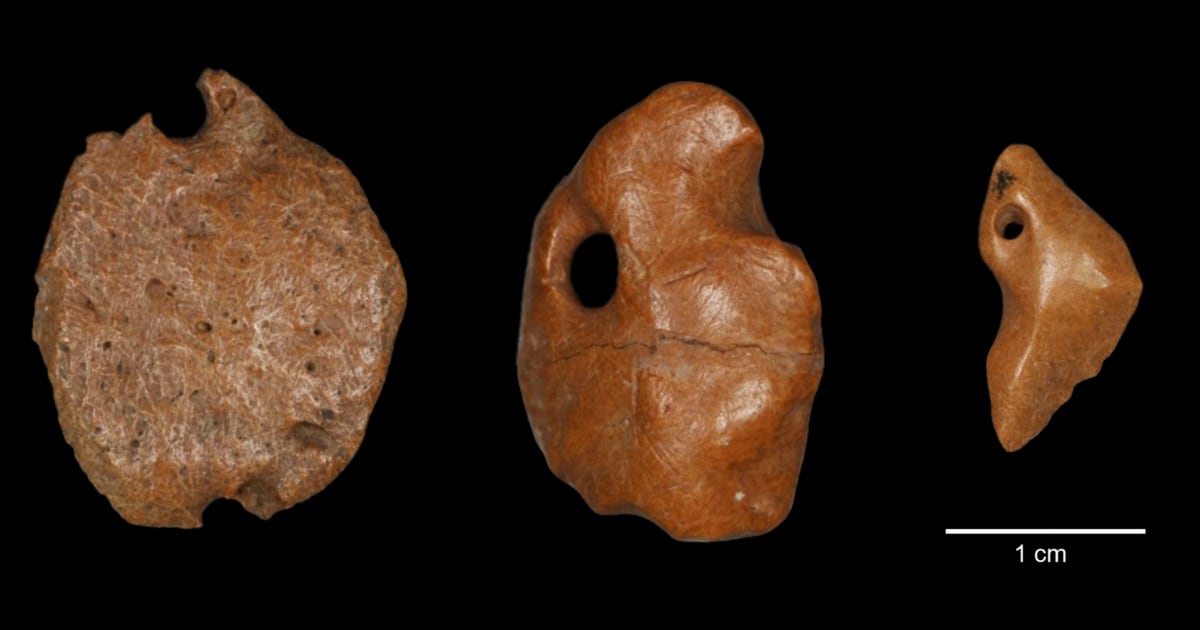
New research suggests that humans lived in South America at the same time as the now-extinct giant sloths, reinforcing the evidence that people arrived in the Americas earlier than previously thought.
The scientists analyzed triangular and teardrop-shaped pendants made from bone material from sloths. They concluded that the carved and polished shapes and the drilled holes were the work of deliberate craftsmanship.
Dating of the ornaments and sediments at the site in Brazil where they were found points to an age of 25,000 to 27,000 years ago, the researchers reported. That’s several thousand years before some earlier theories suggested the first people arrived in the Americas, after migrating from Africa and then Eurasia.
“We now have good evidence, along with other sites in South and North America, that we have to rethink our ideas about human migration to the Americas,” said Mirian Liza Alves Forancelli Pacheco, study co-author and archaeologist at Centro Universidad Federal of Sao Carlos in Brazil.

In the past decade, other research has challenged the conventional wisdom that people did not arrive in the Americas until a few thousand years before sea level rise covered the Bering land bridge between Russia and Alaska, perhaps a few years ago. 15,000 years.
The ornaments were discovered about 30 years ago in a rock shelter called Santa Elina in central Brazil. The new study is the first to look at them extensively and rule out the possibility that humans found and carved them thousands of years after the animals perished.
The team of researchers from Brazil, France and the United States said their analysis shows that this manual labor was done between a few days and a few years after the animals died and before the materials became fossilized. The researchers also ruled out natural abrasion and other things that could explain the shapes and holes. They reported their findings Wednesday in the British journal Proceedings of the Royal Society B.
“We think they were personal items, possibly for personal adornment,” said Thais Rabito Pansani, co-author and paleontologist at the Federal University of Sao Carlos in Brazil.
Once among the largest creatures in South America, giant ground sloths were 10 to 13 feet long and generally walked on all four legs, using their sharp claws to dig burrows. They weighed over a thousand pounds, and their skin included bony structures under their fur, somewhat similar to the bony plates of modern armadillos.
Two years ago, another team of researchers reported that fossilized human footprints found near White Sands, New Mexico, date to 21,000 to 23,000 years ago, though some researchers dispute these dates. Other evidence from Mexico suggests human presence as early as 26,000 years ago, and finds from Uruguay may suggest human occupation as early as 30,000 years ago.
Jennifer Raff, an anthropological geneticist at the University of Kansas, who was not involved in the study, said the new paper was “an important addition” to the conversation, but like any finding on the subject, it can also generate rejection.
Still, the evidence from multiple sites forces scientists to reconsider old assumptions that people arrived only in one big wave of migration across the Bering land bridge, said Briana Pobiner, a co-author and a paleoanthropologist at the National Museum of Natural History. from the Smithsonian Institution in Washington. .
Some may have gone extinct, “but it’s very likely that multiple waves of people have come to the Americas,” he said.


