


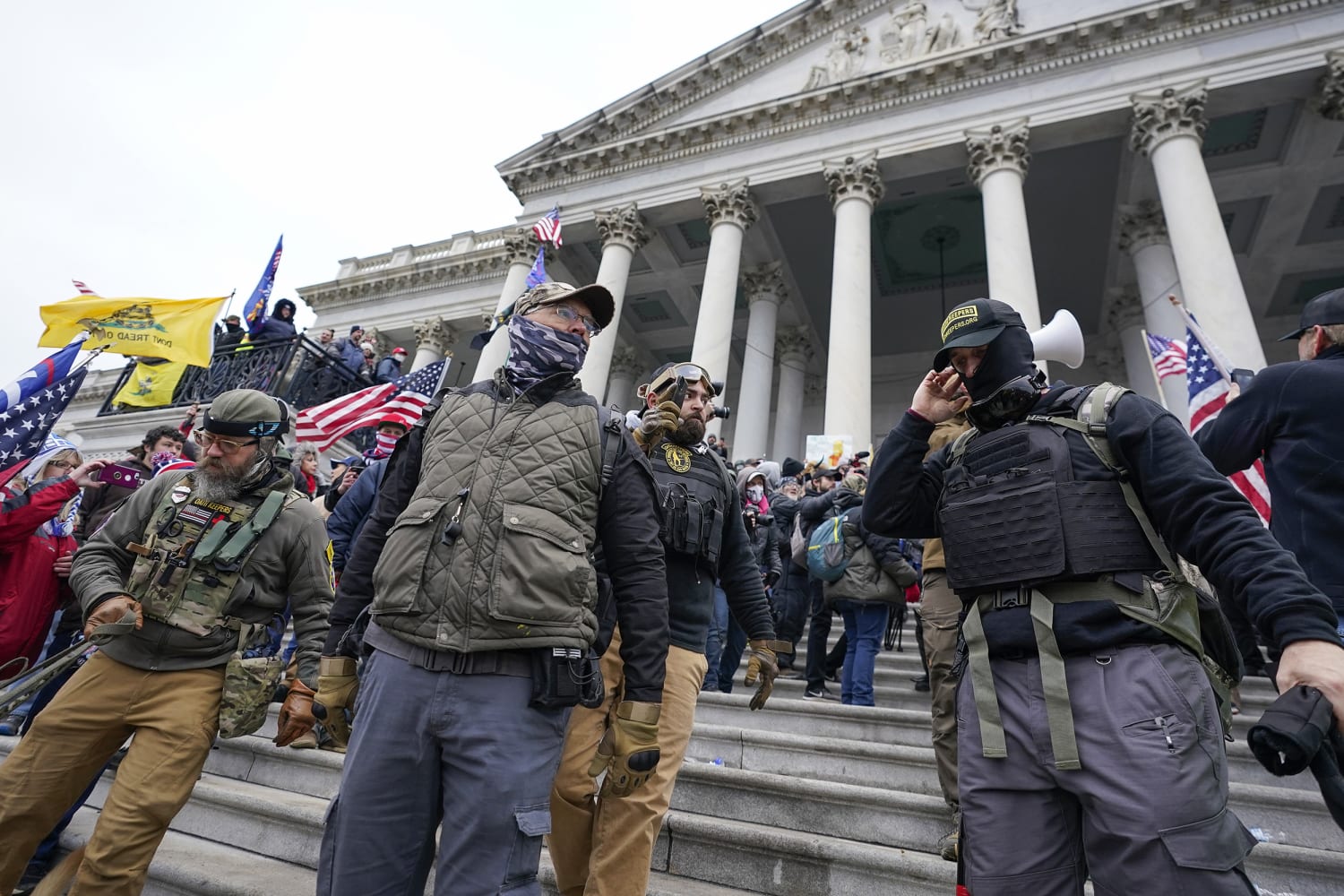
WASHINGTON — A jury on Monday convicted four members of the Oath Keepers of seditious conspiracy in the second batch of guilty verdicts related to the extremist group’s efforts to block certification of the 2020 presidential election.
In addition to the rarely used charge of seditious conspiracy, all four (Roberto Minuta, Joseph Hackett, David Moerschel, and Edward Vallejo) were convicted of obstruction of official proceeding and conspiracy to obstruct.
US District Judge Amit Mehta ordered the four placed under 24-hour house arrest with limited exceptions and limitations on Internet use until sentenced, “despite the nature of these charges, which without doubt they are serious.”
Moerschel’s attorney, Scott Weinberg, told reporters that “we are quite disappointed with the verdict” and that they plan to appeal.
He said Moerschel and the other defendants were “washed away by the ‘Stop the Steal’ nonsense that was pushed by the president”, adding: “While people are responsible for their own actions, I think it’s important let all people take stock” and “Take everything with a grain of salt, because when you follow someone blindly, you end up in a terrible situation.”
The jury began deliberations Thursday morning after a five-week trial.
Prosecutors said the four used a “perverted version of American history” to justify their actions on January 6, 2021.
“Attacking the Capitol was a means to an end,” Assistant US Attorney Louis Manzo told the jury during closing arguments Wednesday. He said the group seized on the riot and used the opportunity to fulfill its goal of preventing Congress from counting electoral votes and confirming Joe Biden as the winner of the 2020 presidential election.
“January 6 was just a battle. The whole conspiracy was to stop the transfer of power,” Manzo said.
Prosecutors said Vallejo was organized at a Virginia hotel with a reserve of rifles, which they called a “Rapid Reaction Force,” while Hackett, Moerschel and Minuta led groups to breach the Capitol.
The trial, which began on December 12, included testimony from Brian Ulrich, a member of the Georgia chapter of Oath Keepers who pleaded guilty to seditious conspiracy and obstruction of official proceeding. Ulrich testified that he participated in the storming of the Capitol because he wanted to stop the Electoral College vote count.
“There is no other reason to go into that building at that time,” Ulrich said.
Manzo also pointed out to the jury fragments of a selfie-style video of Minuta, recorded in what appears to be his car. In the video, an angry Minuta yells about the fake ballots, complaining that Congress hasn’t done enough to fix the problem and saying that children would become “slaves” if people don’t act.
“Millions will die,” Minuta said in another clip from the same video. “So what. So what. … I’m not scared, and I’m ready to go.”
The four defendants were charged as part of the same seditious conspiracy case involving Oath Keepers founder Stewart Rhodes, which went on trial in October. The case was split into two trials due to the number of defendants.
Rhodes and Kelly Meggs, the leader of the group’s Florida chapter, were convicted of seditious conspiracy in November. Three additional defendants from the first trial, Jessica Watkins, Kenneth Harrelson, and Thomas Caldwell, were acquitted of seditious conspiracy but convicted of other felonies, including obstruction of a federal proceeding. All five are awaiting sentencing.
Weinberg said after Monday’s verdict that his client would have been better off if he had been on trial with Rhodes. “I would have someone to point to, being like this is the true bad boy. That’s why I think there was a discrepancy in the verdicts.”
Minuta’s attorney, Bill Shipley, told reporters that he did not believe it was possible for the four defendants to get a fair trial from Washington juries, whom he called “residents of a small judicial district who in a way or another, almost all of them were affected by the events of January 6”.
A third seditious conspiracy trial is underway involving members of the Proud Boys, another extremist group accused of trying to disrupt the peaceful transfer of power. in federal court in Washington.
The maximum sentence for seditious conspiracy, a rarely used Civil War-era statute, is 20 years in federal prison.
Lawyers for the defendants in the second trial they said in their opening statements that their clients did not conspire to overthrow the government.
Defense attorney Angela Halim argued that Hackett, who said he had no military or law enforcement experience, was included in a “narrative” crafted by prosecutors about the Oath Keepers.
“There was no plan to attack the Capitol. There was no plan to disrupt the Electoral College proceeding,” he said of Hackett, who was seen on CCTV video inside the Capitol on January 6.
Weinberg took a similar tack. “This is not a highly organized group,” he said.
“These guys had Twitter fingers, not trigger fingers,” Weinberg said, referring to hip-hop artist Drake’s lyrics.
Vallejo, an Arizona resident, veteran and former Oath Keeper, arrived in Washington on January 6 with “nothing but a servant’s heart,” his lawyer told the jury.
“Ed brought 30 days worth of food with him, not just for himself but for a group, and he thought he would go to a camp where he would set up a kitchen and cook for the protesters,” defense attorney Matthew Peed said in opening remarks. . “And it would be a kind of festival.”
He also emphasized that Vallejo had not met his co-defendants until the day of jury selection at the trial.
“There was literally zero coordination between these people,” Peed said.


