

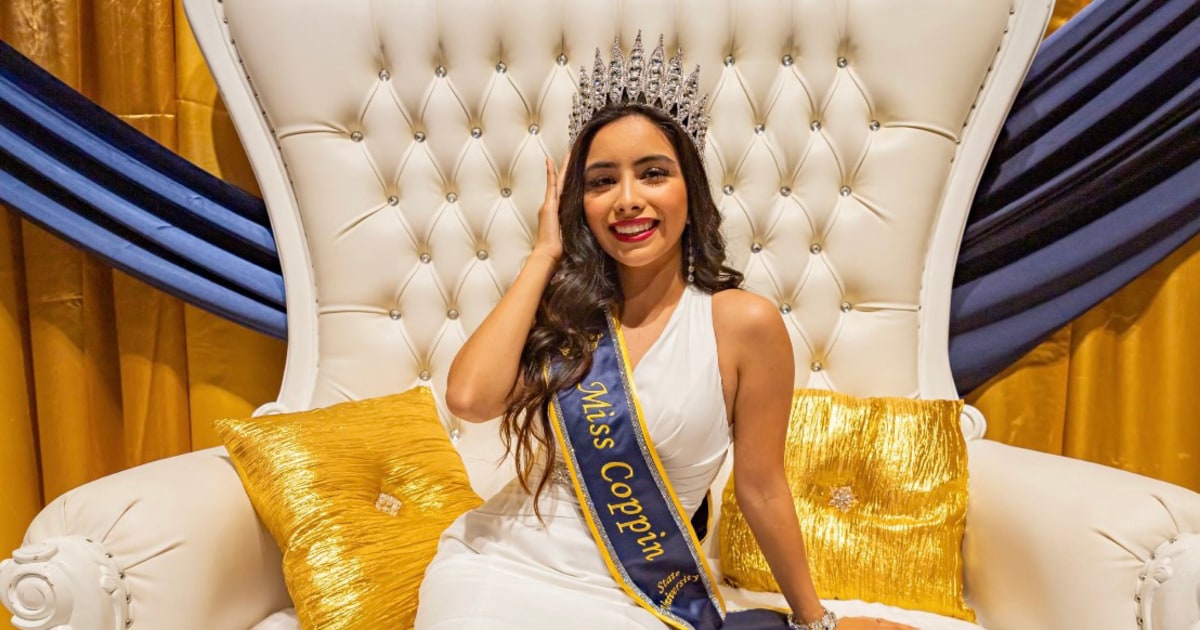
When Keylin Pérez became the first Latina to be crowned Miss Coppin State University in Baltimore, she was thrilled. She had previously been named the university’s Miss Sophomore and Miss Junior and she was eager to continue to proudly represent the school as the 91st Miss Coppin State University queen.
but after a The TikTok video he posted went viralit received backlash, including harassment, from online critics who said the role should be given to a black woman, as Coppin State University is a historically black university. known as HBCU.
“I never considered resigning,” Perez told NBC News. She applied for the high-profile role knowing she could face backlash, but she was unopposed and she was officially crowned in October. “I stood by my decision to continue serving my institution that has invested so much in me in the last four years,” she said.
The original TikTok video featured Perez and Mister Coppin State and their Royal Court counterparts at Morgan State University, another HBCU in Baltimore, recreating a scene from the movie Zoolander, which was a trending meme at the time on the platform. The group recorded the joyous video at the Mister HBCU Kings, Inc. Leadership Conference and Competition, held in St. Louis.

Since then, the video has garnered more than 430,000 views, more than 78,000 likes, and more than 2,700 comments before Perez disabled the comments section due to the deluge of hate messages.
Dozens of videos and posts also surfaced on other platforms, including Instagram and Twitter, raising bigger questions about representation, race and legacy, and debating whether crowning a non-Black person contradicts HBCU culture.
Perez, who turns 23 on Saturday, said the online reaction intensified as some of the comments became vulgar, with some even suggesting she hurt herself.
Perez took to Instagram to address the controversy and issued a statement. The post received more than 1,000 comments with divided opinions.
“They’re going to have to start removing ‘Black’ from titles now,” said one commenter, while another said, “Most support you and stand with you. You’re doing amazing honey. Please continue to serve your campus with grace.”
Kelaina Slaughter, 20, a junior English major at the University of Louisville in Kentucky, first learned of the controversy surrounding Perez in a different TikTok video.
Slaughter explained why she thinks a role like Miss Coppin State University should go to a black person.
She said roles like the Royal Court seats at HBCUs are crucial to representing students who have historically been underserved in predominantly white institutions.
“The reason why it is so important that these people are black is so that they can have black voices in spaces where they historically were not allowed. They are trying to show that we are educated, that we can fill these positions, that we can have the same thing as white people, anybody else,” Slaughter said.
“When you take away those spaces, you’re taking away an additional voice for our community that you can have in a national space and allow it to represent our community as a whole,” Slaughter continued.
However, Pérez says that he has received support from his peers, professors and university administrators.
Perez noted that the controversy is in stark contrast to her time as Miss Sophomore and Miss Junior. She did not receive any backlash then, she said.
Justin Evans, 23, president of Coppin’s student government association, said Perez “has our full support.”
“I feel like it’s brought us together even more than before, because we’re already a small institution, so all this backlash,” he said, “it just helps us realize how we’re all we’ve got in a sense. Campus life actually been up.”
Evans, who is black and Mexican-American, said Perez has been one of the most impactful queens the school has had thus far. She also said Perez has been featured all over campus and on the school’s website since her time as Miss Sophomore and Miss Junior.
Jawaad Williams, 20, who is Mister Junior at Coppin, said of the controversy: “I think sometimes people just get caught up in the idea, like an HBCU is just for blacks and no one else can go to the school”.
Before the backlash on social media, no one on campus questioned Perez’s coronation, Williams said, because “we all felt he deserved the place he occupies.”
“She goes above and beyond. She doesn’t just wear the crown and take pictures. She actually goes out into the Baltimore community and works. She works on campus. So she’s very active in her role,” she said.
Queens of other HBCUs too posted a video and statement in support of Pérez.
Other HBCUs in the past have faced a similar backlash for choosing non-black queens, including Kentucky State University.
Historically black, but increasingly diverse
HBCUs are defined as institutions founded before 1964 with the specific mission of educating black students amid the realities of legal segregation. But in recent years, population growth and demographic changes have affected the composition of the students. Non-black students accounted for 25% of HBCU enrollment in 2021, up from 15% in 1976according to the National Center for Educational Statistics.
Coppin State University President Anthony Jenkins addressed the issue of a multicultural campus at an online video statement denouncing the “racist, hurtful and unintelligent comments made by various people” in response to the backlash against Perez.
“We are a proud HBCU educating a multicultural and multigenerational student population. Therefore, we value diversity and inclusion. As such, we do not buy into the myth that the students representing our HBCU must be African American,” Jenkins said. “We will not allow irrelevant enemies to make our queen feel that she does not belong or that she is not worthy of representing our beloved institution.”
Pérez, of Guatemalan descent, attended a public high school in Glenelg, Maryland. “I never really felt like I fit in, knowing that there were less than five Latino students and less than 20 black students and the rest were white,” Perez said.
She said she was drawn to Coppin State for its smaller classroom size ratios and diverse student population. Coppin State’s student body is 80% Black, 3.1% Hispanic or Latino, and 1.7% White.
“When I came to Coppin, I really felt welcome,” Perez said. “They pushed me, they inspired me, and I felt that when I came to his guidance, I found everything I ever wanted in a university.”
Perez is a senior who is expected to graduate in May as a nursing and military science major. He also serves as a sergeant in the US Army Reserves and plans to become a psychiatric nurse practitioner within the military.
For Latinos interested in attending an HBCU, Perez said she recommends schools and advises prospective students to take an orientation tour to learn more.
Ashley Román, 21, a student-athlete for the Coppin women’s volleyball team with a pre-med biology major, is from Isabela, Puerto Rico. Choosing to attend an HBCU, she said, has been one of her best experiences.
“Here, I have always, always, always felt comfortable enough to call this my second home,” Román said. “Just because it’s an HBCU, they don’t exclude students based on race and always involve everyone.”


