

The Chinese spy balloon that flew over North America earlier this year exposed major gaps in the United States’ ability to detect airborne threats and spurred the development of new surveillance technologies, the top US commander responsible for patrolling the skies told NBC News in an exclusive interview.
General Glen VanHerck, head of the US Northern Command and North American Aerospace Defense Command (NORAD)He told “Nightly News with Lester Holt” that US surveillance capabilities have been strengthened with new technology since the balloon was detected off Alaska earlier this year.
“We weren’t looking for a high-altitude balloon at the time: 65,000 feet, very slow. Our radars are able to see it, but we were leaking that data,” he said recently in a wide-ranging interview at the Colorado Springs headquarters for NORAD, which monitors the skies over the US and Canada and responds to potential threats.
Catch more of Thursday’s interview on “NBC Nightly News with Lester Holt” at 6:30 pm ET/5:30 pm CT.
The Biden administration came under fire for its handling of the Chinese surveillance balloon, first reported on by NBC News, with some questioning why it was allowed to fly over sensitive military sites in the continental United States, where it could gather valuable information on American defenses. The revelation that the Chinese were able to fly such balloons in US airspace without being detected by the US military also raised questions about an intelligence failure, prompting calls for more investment in the country’s air defense and radar systems.
China initially apologized for the incident, but maintained the object was a civilian weather balloon that had drifted off course.

VanHerck, like other US officials, said there was no question the balloon was being used for spying.
“We know for sure that it was a spy vehicle,” he said.
VanHerck admitted that the incident, which captivated the country and brought US-China relations to a new low, had been a learning experience.
“We learned significantly: I also learned that I need to be able to see further, farther into the Pacific, further into the Arctic and into the Atlantic,” he said.
“And that’s what over-the-horizon radars will give us,” he added, referring to systems that detect objects at very long distances.
VanHerck said he first learned of the balloon on Jan. 27 and his forces intercepted it the next day with F-22 and F-16 fighter jets, determining it was not a hostile threat.
On February 2, NBC News reported that the balloon was flying over the US. It was shot down off the coast of South Carolina two days later on the orders of President Joe Biden. The process to identify and intercept the balloon worked “exactly as it should,” VanHerck said.

The balloon was able to collect intelligence from several sensitive US military sites, despite efforts by the Biden administration to prevent it from doing so, two current senior US officials and a former senior administration official told NBC News in April.
VanHerck added that while he was aware that China had a high-altitude hot air balloon program prior to the incident, he was unaware that several balloons had flown over the US.
In addition to being the head of NORAD, VanHerck is also ultimately responsible for the country’s maritime and land defense, including against ballistic missiles, and for supporting civil authorities in responding to natural disasters, including hurricanes and forest fires.
In the event of a ballistic missile launch in the US, it’s your job to provide a warning within minutes.
The challenge of the work is not just the vast geography, from the North Pole to Central America, but how the nature of external threats is constantly evolving into scenarios that could not have existed when NORAD was founded during the Cold War in 1958.
“Hypersonics, for example, or extremely low radars, cross-sectional cruise missiles, or advanced submarines that are very quiet…those are the overwhelming tasks I experience, not necessarily the size of the area of responsibility,” he said.
“Honestly, what worries me the most is the cyber domain and our ability to understand the threats in the cyber domain that affect our power projection,” VanHerck said.

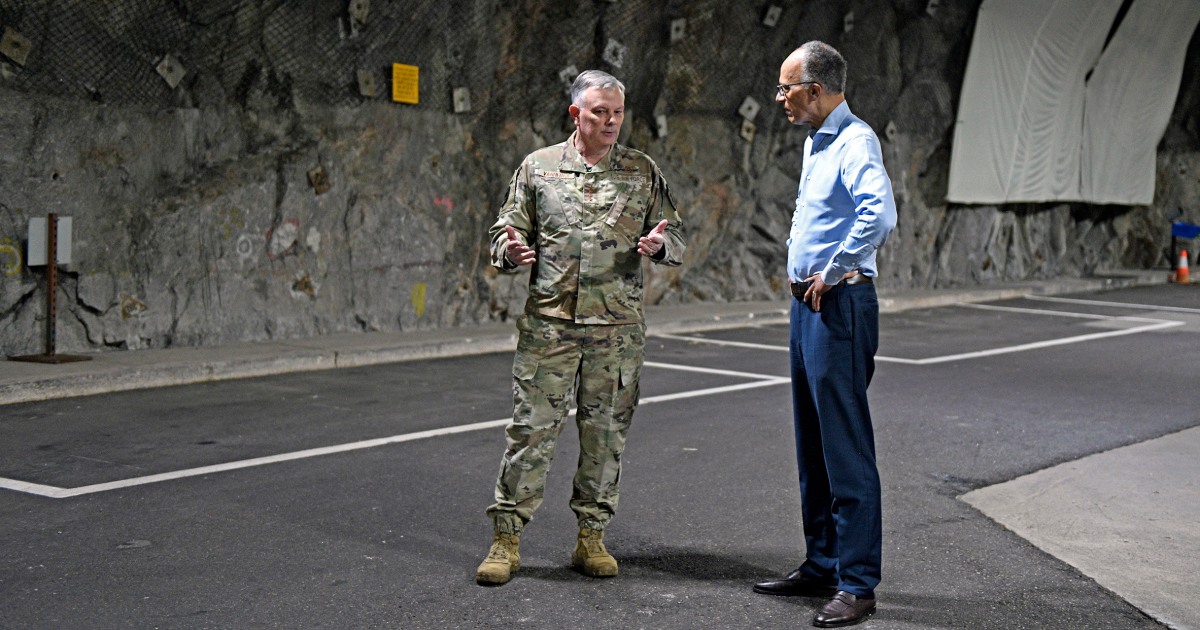
NBC News also conducted a tour of the nearby Cheyenne Mountain Resortwhich has been in use since 1966 and is designed to provide “continuity” of operations for military and civilian authorities in the event of war.
The site has a series of three-foot-thick blast doors, capable of withstanding a nuclear blast. The last time the complex was operationally closed was at the time of the September 11, 2001 attacks in the United States.
Despite the facility’s construction during the Cold War, VanHerck said the current global climate is the most challenging and dynamic he has seen in 36 years of service.
“Two nuclear-armed competitors,” he said, referring to China and Russia as current US threats, to which he noted are joined by many others: “violent extremists and an unstable world” and “international norms that have served us well since the end of World War II are being challenged every day,” he said.


