

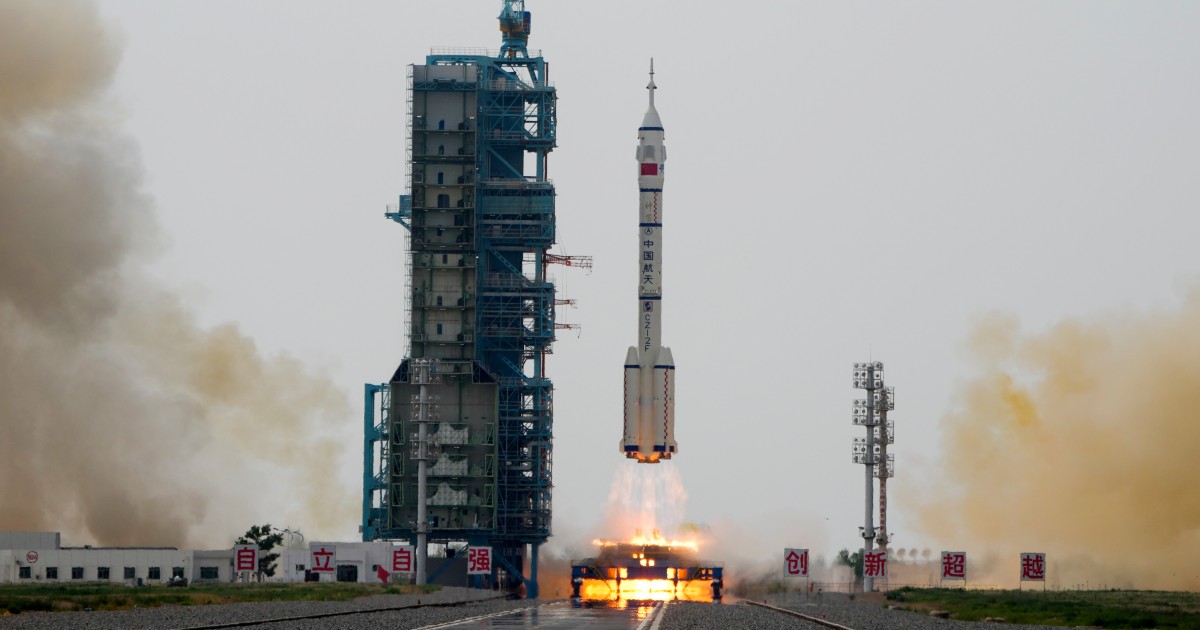
BEIJING — China on Tuesday launched a new three-person crew for its orbiting space station, aiming to land astronauts on the moon before the end of the decade.
The Shenzhou 16 spacecraft lifted off from the Jiuquan launch center on the edge of northwest China’s Gobi desert on a Long March 2-F rocket shortly after 9:30 a.m. Tuesday (9:30 p.m. Monday, Eastern Time).
The crew, including China’s first civilian astronaut, will briefly overlap with three now aboard the Tiangong station, who will then return to Earth after completing their six-month mission.
A third module was added to the station in November, and space program officials said Monday they have plans to expand it, along with launching a crewed mission to the moon before 2030.

China built its own space station after it was banned from the International Space Station, largely due to US concerns about Chinese space programs’ intimate ties to the People’s Liberation Army, the military branch of the ruling Communist Party. .
China’s first manned space mission in 2003 made it the third country, after the former Soviet Union and the United States, to send a person into space using its own resources.
On this latest mission, payload expert Gui Haichao, a professor at Beijing’s top aerospace research institute, will join mission commander Major General Jing Haipeng, who is making his fourth spaceflight, and spacecraft engineer space Zhu Yangzhu.
The crew will remain on board the station for around five months, during which they will carry out scientific experiments and regular maintenance.

The mission comes against the backdrop of a rivalry with the US to reach new milestones in space. That has largely been amicable, but it also reflects their growing competition for leadership and influence in the technological, military and diplomatic fields.
American spending, supply chains and capabilities are believed to give it a significant advantage over China, at least for now. However, China has erupted in some areas, bringing back samples from the lunar surface for the first time in decades and landing a rover on the far, less-explored side of the moon.
Meanwhile, the US is aiming to get astronauts back on the lunar surface by the end of 2025 as part of a renewed commitment to manned missions, with the help of private sector players like SpaceX and Blue Origin.
In addition to their lunar programs, the two countries have also landed rovers on Mars separately, and China plans to follow the US in landing a spacecraft on an asteroid.


