


Contents
- daniel brown
- BBC World, Caracas
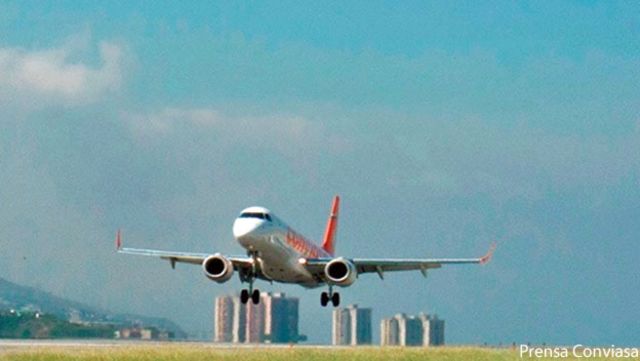
image source, BBC World Service
“He who leaves does not return,” President Nicolás Maduro often says about the airlines that have reduced or suspended their flights to and from Venezuela in recent months.
“For that we have Conviasa,” the president has pointed out more than once in reference to the Venezuelan state airline.
November 28 marks the tenth anniversary of the first flight of Conviasa, a company created by the then president, the late Hugo Chávez, with the promise of making it the flag carrier of Venezuela.
But today Conviasa is synonymous with inefficiency for many Venezuelans: complaints about its delays, failures and poor service are a constant.
The government insists that the airline is not only going to expand, but that it can respond to the reduced supply of tickets in Venezuela.
In the last year, national tickets decreased by 59% and international ones by 29%, according to the Venezuelan Association of Travel and Tourism Agencies (Avavit).
Can Conviasa take advantage of the lack of supply from its competitors?
“Best Teams”
“Conviasa is the Venezuelan airline that is in the best conditions to grow,” the president of the Venezuelan Airlines Association (Alav), Humberto Figuera, told BBC Mundo.
“It has the best equipment, the latest technology and the potential to expand its market to routes that are in high demand, especially in the United States,” he says.
Last year, Conviasa bought ten Embraer 190s, a Brazilian-made plane.
The Embraers completed a fleet of 32 Conviasa aircraft, which is the newest of the Venezuelan airlines. And more aircraft are expected before the end of the year.

image source, BBC World Service
In ten years, Conviasa has registered seven accidents, the worst of which was in 2010 (photo) in the Venezuelan state of Bolívar, in which 17 people died.
“Huge Income”
Apart from the Embraer, Conviasa spent US$75 million in maintenance, personnel and operation in 2013, according to the Memoria y Cuenta of the Ministry of Water and Air Transport, on which the airline depends.
And it had income of just over US$274 million (at the official exchange rate of 6.3 bolivars per dollar), according to said rendering of accounts.
“Conviasa’s revenues are enormous,” says a high-level official from a government entity in the sector who asked not to be named.
“The airline does not pay taxes, gasoline, parking, airport taxes or Radio aids.”
But an official statement from Conviasa sent to BBC Mundo contradicts this point and says that the airline is “self-sustaining” and pays its airport taxes.
BBC Mundo met with the Minister of Transportation and the president of the National Institute of Civil Aeronautics, but received no response.
stranded passengers
In a media case, a month ago three Conviasa flights going from Madrid to Caracas were delayed for several days and left more than 400 passengers stranded for up to a week in the Spanish capital.
When they returned to Caracas, some of the passengers reported that their suitcases had been looted during the trip.
Something similar happened on a Caracas-Buenos Aires route.
Both flights were on planes that Conviasa hires under the figure of ACMI leasean agreement that airlines usually sign with other companies in extraordinary situations.
“Payment delays in these contracts are usually the reason for the cancellation of Conviasa’s European flights,” Thomas Jaeger, director of Conviasa, told BBC Mundo. ch-aviationa Swiss-based aeronautics consultancy that has followed the Conviasa case for years.
However, Conviasa points out that these cases “obeyed a special condition” of the airlines (Blue Panorama in the case of Madrid and Dynamic Airway for Buenos Aires), “and not due to lack of payment” of the ACMI contract.

image source, BBC World Service
Experts assure that the delays in the Venezuelan airlines in general are due to lack of spare parts and pilots.
“bad service”
Meanwhile, Roberto León Parilli, president of the National Alliance of Users and Consumers (Anauco), says that the cases of stranded passengers “were not isolated events.”
“We receive complaints of this type about Conviasa on a daily basis: the user has no claim rights, they do not pay compensation, nothing works,” he says.
“Flights are often overbooked and the only way to get on the plane is by paying a commission or meeting an airline official,” he says.
However, the airline says that “Conviasa’s security management has managed to address about 20 complaints and has taken corrective measures to prevent these events, which are far from being called ‘overbooking’.”
“unusual” practices
In ten years, Conviasa has registered seven accidents, the worst of which was in 2010 in the Venezuelan state of Bolívar, in which 17 people died.
In 2012, the European Union banned Conviasa from flying in Europe due to “security concerns”.
The airline began contracting for aircraft, crew, insurance, and maintenance through ACMI for its European flights.
Although the sanction was lifted in 2013, Conviasa maintained its ACMI contracts with European airlines.
“Given that they have a bad reputation and have been penalized, it’s very likely that they are losing a lot of money on those contracts that by definition don’t have much of a profit margin,” Jaeger says.

image source, BBC World Service
There are those who say that Conviasa flights are often overbooked, presenting strong queues at the airport.
Maintenance and spare parts
According to this expert, another of the problems facing the airline is the lack of spare parts.
“That is the case of the plane that they have parked in Bordeaux (France) because it does not comply with the regulations,” Jaeger explains of a 1993 Airbus A-340.
Conviasa’s fleet is particularly heterogeneous: its 32 aircraft, of which 20 are active according to Jaeger, are from six different manufacturers.
The Ministry, in its 2013 Report and Account, acknowledges that this diversity in the Conviasa fleet translates “into a high increase in costs for the acquisitions (of spare parts).”
As part of the economic crisis that Venezuela is experiencing, imports of spare parts for all types of vehicles have been significantly reduced.
no pilots
Jaeger adds that the new fleet is not without its drawbacks.
“They don’t have specialized Embraer pilots, so they hire them abroad, which costs them about five times what they would be paying if they had them,” he says.
On this, Conviasa assures that they have 16 pilots in the process of training at Embraer in France and the US.
Meanwhile, the government official who spoke to BBC Mundo says that the lack of pilots is one of the main reasons for delays in domestic flights, which are frequent.
“Many Venezuelan pilots have left the country and the airlines have been short of crews,” he says.
Conviasa assures that in “the last year 397 professionals have been trained in simulators and 650 with theoretical classes”.
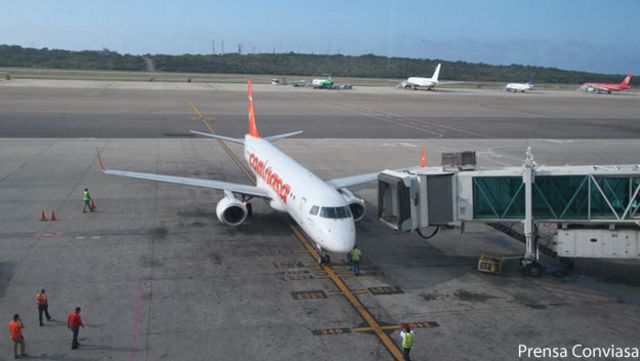
image source, BBC World Service
Conviasa, which bought some Embraer 190 between now and last year, has the youngest fleet in Venezuela.
“Atypical” airline
The sources, with the exception of the airline, agree that Conviasa is an “atypical” airline, managed with different parameters than usual.
One of the reasons is that, according to opposition leaders, the airline reserves the right of admission, because, they say, politicians like Leopoldo López and María Corina Machado have been banned from flying on Conviasa.
The airline says that “in the only cases in which any restriction has been presented in the media, is when they try to use their status or investiture to ignore national aeronautical regulations, incurring, in some cases, in acts considered by law as illegal interference ” .
According to a decree published in 2009, illegal interference is considered “those actions, facts or attempts that compromise the safety of civil aviation and air transport.”
On the other hand, Conviasa is not a member of the International Air Transport Association (IATA), of which 84% of world air traffic is a part.
10 presidents in 10 years
And the experts agree that in Conviasa there has not been continuity or a commercial approach, something that it considers necessary for the viability of a public or private airline.
In a decade, Conviasa has gone through several ministries and has had ten different presidents, most of them military.
And, unlike other airlines, Conviasa “does not have a fluid relationship with travel agencies,” according to the president of Avavit, Sandra González.
In order for it to resolve the airline crisis, “Conviasa should be managed by the private sector, with a healthy cash flow and without a subsidy policy,” Ricardo Cusanno, president of the Conseturismo chamber, told BBC Mundo.
Conviasa, concludes the official, “is like the son who turned out to be spoiled because you spoiled him too much.”
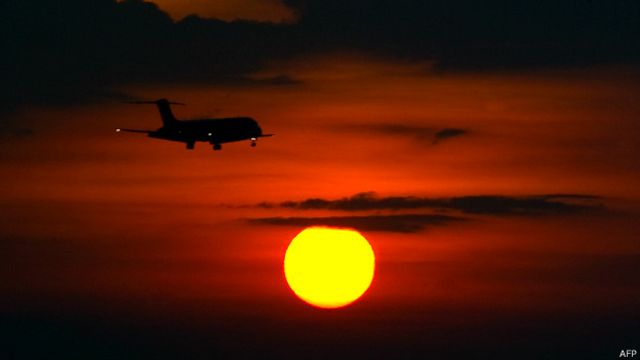
image source, AFP
Plane landing at the Maiquetía airport, Caracas.


