

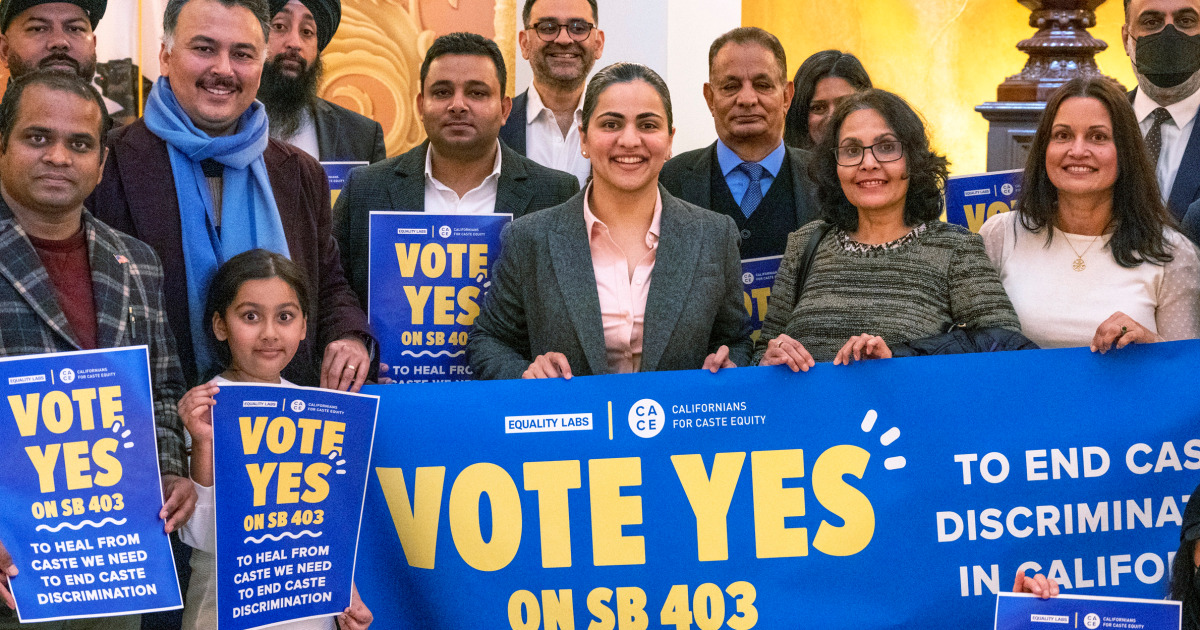
A bill that would make California the first state to ban caste discrimination cleared another hurdle this week when it passed unanimously by the state Assembly Judiciary Committee, with crucial revision.
The legislation, SB 403, originally sought to add caste as a new category under the state’s nondiscrimination law, but now lists caste as a protected class under the broader umbrella of “ancestry.”
Opponents of the bill hailed the passage of what they see as a watered-down version, but supporters said it was still a victory. The legislation mentions and defines caste for the first time in California history, they said, and is now one step closer to becoming law.
“There were so many attempts to kill the bill and eliminate ‘caste’ altogether,” Thenmozhi Soundararajan, a caste equality activist and founder of civil rights organization Equality Labs, told NBC News. “For us to preserve it is an incredible victory”.
The bill, which passed 9-0 with two abstentions on Wednesday, passed the state Senate in May and now goes to the state Assembly Appropriations Committee. If it passes there, it will go to the Assembly floor and ultimately to Gov. Gavin Newsom to become law.
The caste system, an inherited social hierarchy in South Asia, has been used for centuries to deny mobility and civil rights to those born into the lowest classes. It has been outlawed in India, but advocates say its effects linger, including violence and exclusion on the subcontinent and in the diaspora.
A growing movement in the US spanning universities, businesses, and cities has sought to educate the American public about the harms of caste discrimination and pass laws prohibiting it. Seattle was the first city in the country to do so.
“The process that we’ve built, the many leaders that have come forward, it’s been an incredible experience,” said Soundararajan, who also founded the Californians for Caste Equity Coalition.

But a countermovement has grown along with the push for caste equality, and other American Indian groups have come out in large numbers to protest bills like SB 403, arguing that there is no reason to protect people in the US. lower-caste-born U.S. citizens and in doing so targets South Asians.
After consideration by the Judiciary Committee, the proposed bill moved from adding caste as a separate protected category to specifying it as a subset of ancestry.
Assemblyman and Judiciary Committee Chairman Brian Maienschein and committee attorney Tom Clark did not respond to requests for comment.
Advocates feel the revised version of the bill is something everyone can get behind. The American Indian Foundation, which has been outspoken against SB 403, praised the amendments, saying they dilute the emphasis on caste.
“But for ‘caste’ to be added as a clarification of ‘ancestry,’ we are pleased to see suggestions and language that we proposed be used to significantly modify the bill,” the foundation’s executive director, Suhag Shukla, said in a statement. release.
State Senator Aisha Wahab, who wrote the bill, says this narrative is far from true. The amendments will not change how the bill can be applied if it becomes law, she told NBC News.
“The amendments represent a concept in the bill that my office discussed at length weeks ago, and these amendments ensure justice for those who suffer caste discrimination,” he said. “We consulted with civil rights and discrimination attorneys on these amendments, and there is nothing here that dilutes the ability of anyone who experiences caste discrimination to bring a claim.”
Opponents still take issue with caste being mentioned, saying it unfairly targets South Asian communities by associating them with the caste system. But Soundararajan disagrees, saying that it is necessary to educate people about the history and harms of the castes in order to do justice and move forward.
“The majority of the South Asian community and the majority of Californians don’t want discrimination to happen in the state,” he said. “The bill in its current form: there should be no objection if our opponents really do come in good faith to end discrimination.”
“I’m very proud of us as we go through this moment,” Soundararajan said. “He has shown how much we can build in a very fast time for our freedom. It’s a ray of light in a time of great darkness that we can still make some progress for civil rights.”


