


image source, Public plaza
Byron Lima is Guatemala’s strongest non-gang prisoner.
“Let the judge come. Let’s see the great expense and ridiculousness of the state security forces!” exclaimed Byron Lima on Friday, February 15, 2013, with the impunity that power makes people feel, believing themselves untouchable.
Until then it was. But the former captain of the Guatemalan Army, sentenced to 20 years in prison for collaborating in the murder of Monsignor Juan Gerardi, had been recaptured, for “evasion”, not escape. For going out “for a walk”, something he apparently did frequently.
This was announced by the Ministry of the Interior, with hype and cymbal. And the case also cost the then director of the prison system his job.
But the news expired in a day. On February 16, the judge on duty dismissed the charge brought against him by the Public Ministry, the Prosecutor’s Office, in the same way as on 13 other previous occasions.
Byron Lima, the most powerful “paisa” inmate, the strongest prisoner among those who do not belong to the gangs, continued to be armored.

image source, Public plaza
The ex-military declared before the judge on September 13 and 16.
These days Lima is trying to make a “ridicule” of those who dared to impute him, as he promised that time.
“Leader” of criminal network
The International Commission against Impunity of Guatemala (Cicig), a temporary body of the United Nations, returned to appear before the judge; something that the last three governments cannot.
This body has the attributes of an international prosecutor but operates under Guatemalan law, was able to present evidence that places Lima at the head of a criminal organization and in which the head of the General Directorate of the Penitentiary System, Édgar, was allegedly involved. Camargo.
According to the investigation, the main criminal activity of the group was the transfer of prisoners from one prison to another. And for each of the transfers, Camargo charged about US$6,000.
Camargo was arrested on September 3.
In addition, Lima is accused of money laundering, illicit association, influence peddling and illegal use of mobile phones in prison.
Before Cicig “redirected” the investigation, for years the Prosecutor’s Office had opened 12 criminal cases against the ex-military, for cases ranging from threats, extortion and assaults, to drug trafficking.
In September 2009, the Human Rights Ombudsman opened a file on him. He was accused of subjecting 12 inmates from Pavoncito, the prison in which he is convicted, to physical and psychological punishment. According to a complaint, Lima gave the orders and 50 prisoners under his orders complied with them to the letter.
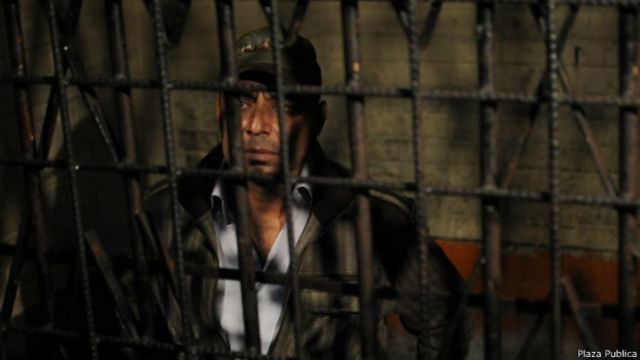
image source, Public plaza
According to the investigation, the network that Byron Lima allegedly directs from the Pavoncito prison is in charge of illegal transfers of prisoners.
However, all these attempts were dismissed -such as the one related to “evasion”-, archived or the necessary evidence was not obtained to go before a court.
They didn’t even transfer Lima to another prison. And that taking into account, furthermore, that Pavoncito is a preventive center and Lima has already been sentenced, so it should not be there.
“I know the business well”
So how did the Cicig investigation end up in an indictment? What has been the key?
It is Commissioner Iván Velásquez, who heads the organization, who responded to BBC Mundo’s questions.
“The important thing is that we arrived, with a lot of confidentiality, to be able to verify each of the elements found and thus present a very well-sustained investigation,” he explained by phone from Guatemala.
“The key was not to present testimonial evidence, but verification of criminal facts.”

image source, Public plaza
Before the Cicig investigation ended in charges, 13 cases have been opened against Lima.
One of these was a call made by Lima on August 16 from Pavoncito.
“If there were no problem, the other two would already be here, wouldn’t they?”, he asked Carlos Cermeño from prison, one of the alleged links between the ex-military officer and the then director of the prison system.
Lima was referring to the transfer of the brothers Édgar Enrique and Silverio Otto Chicas from León, prosecuted for drug trafficking. The transfer was not made with the same speed as in other cases.
“I have known about this business for 15 years. The truth is that I don’t need anyone’s tail, you,” the recording is heard, according to the newspaper. Free Press.
The most powerful prisoner
“Is Byron Lima the most powerful prisoner in the country, as is being said?” BBC Mundo asked Velásquez.

image source, Public plaza
The director of the Guatemalan Penitentiary System, Édgar Camargo, was arrested on September 3.
“Yes, he was really a very powerful prisoner,” said the commissioner, emphasizing the past tense. “He was in charge of the prison where he was, he was able to transfer whoever he wanted.”
According to the Penitentiary Regime Law, the judges are the only ones who can authorize the transfer from one penitentiary center to another. However, in case of emergency, it allows the General Directorate of the Penitentiary System to decide them, immediately notifying a judge. And that is the loophole that the Lima network used.
The Guatemalan media journalist Public plazaRodrigo Baires agrees with what Velásquez said about the authority of the ex-military.
He has been tracking Lima for two years and assured BBC Mundo: “He is the most powerful prisoner in the country and is accused of the most serious political crime in the last 15 years of Guatemalan history.”
What is clear is that Lima is a prisoner with many contacts and a lot of information.


