


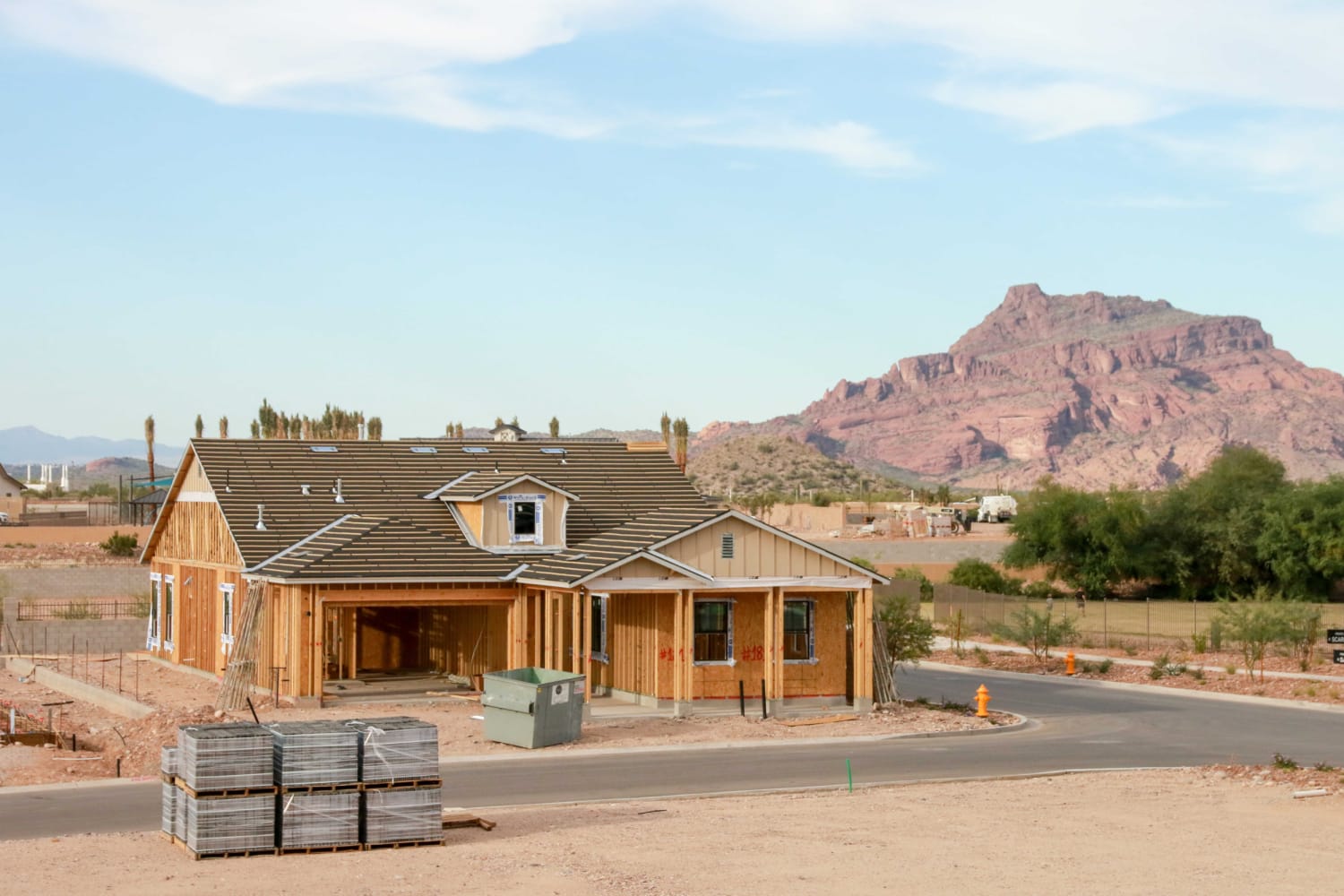
PHOENIX — Arizona will not approve the construction of new homes on the fast-growing edges of the Phoenix metropolitan area that rely on groundwater thanks to years of overuse and a multi-decade drought that is depleting its water supply.
At a news conference Thursday, Gov. Katie Hobbs announced restrictions that could affect some of the fastest-growing suburbs of the nation’s fifth-largest city.
Officials said developers could still build in the affected areas, but would need to find alternative water sources to do so, such as surface or recycled water.
What prompted the state’s decision was a projection showing that over the next 100 years, demand in the Phoenix metropolitan area for nearly 4.9 million acre-feet of groundwater would not be met without further action, Hobbs said. One acre-foot of water is enough for two to three American homes per year.
Despite the move, the governor said the state is not running out of water. “Nobody who has water will lose it,” Hobbs said.
Officials said the measure would not affect existing homeowners who already have secured water supplies.
Hobbs added that there are 80,000 unbuilt homes that will be able to get by because they already have secured water supply certificates within the Phoenix Active Management Area, a designation used to regulate groundwater.
Years of drought in the West made worse by climate change have increased pressure among Western states to use less water. Much of the focus has remained on the dwindling Colorado River, a major source of water for Arizona and six other western states. In the past two years, Arizona’s supply from the 1,450-mile western power station has been shut off twice.
Phoenix relies on imported water from the Colorado River and also uses water from the state’s Salt and Verde rivers. A small amount of the city’s water supply comes from groundwater and recycled wastewater.
The drought has made groundwater, held in underground aquifers that can take many years to replenish, even more vital.
Under a 1980 state law meant to protect the state’s aquifers, Phoenix, Tucson and other Arizona cities have restrictions on the amount of groundwater they can pump. But in rural areas, there are few limitations on its use.
Long driven by farmers and rural Arizona residents with little oversight, Hobbs and other state officials recently pledged to take further steps to protect state groundwater supplies.
In rapidly growing Phoenix suburbs like Queen Creek and Buckeye, developers have relied on unallocated groundwater to prove they had adequate water supplies for the next 100 years, which Arizona requires for building permits in some areas.
“Developers are relying on groundwater because it’s been, frankly, cheaper and easier for them, and they’ve been able to move through the process much faster,” said Nicole Klobas, senior counsel for the Arizona Department of Water Resources.
Under the new restrictions, that won’t be possible.
“Close that path,” said Kathryn Sorenson, director of research at the Kyl Center for Water Policy at Arizona State University.
Because the rule heavily affects cities and towns outside of Phoenix and larger cities in the metropolitan area, Sorenson said developers would likely “consider whether they want to continue to buy relatively cheap land … and incur the cost of developing a completely new water supply versus buying land that is likely to be more expensive without the limits of a designated city.”


