

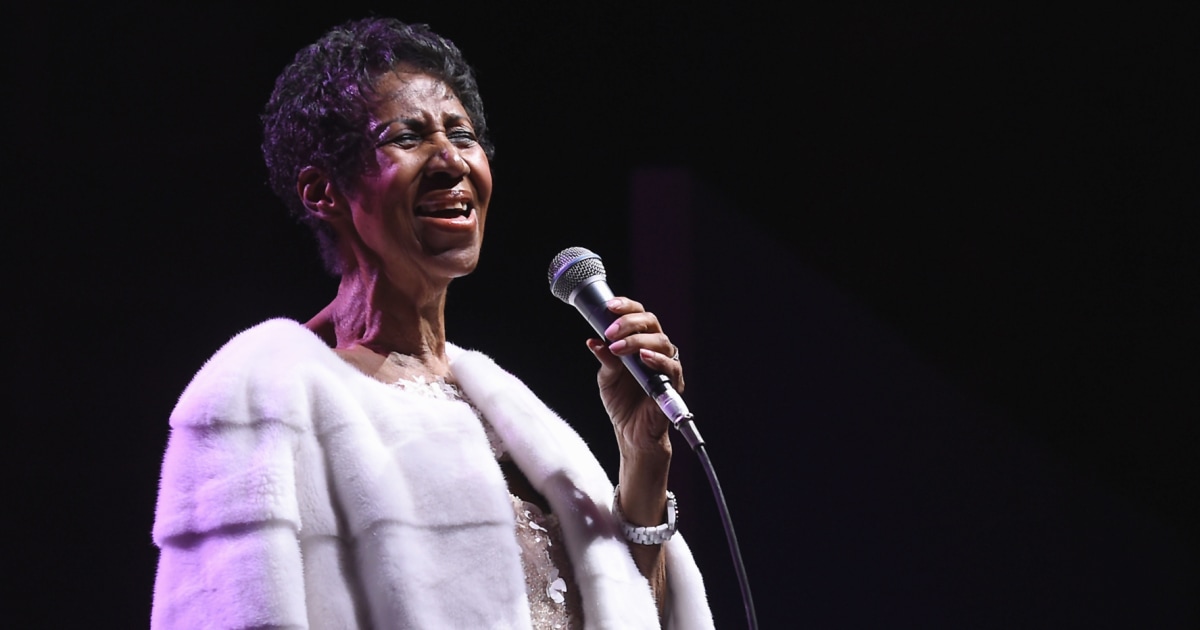

Aretha Franklin, the electrifying “Queen of Soul,” died in August 2018, closing the curtain on one of the most storied careers in American popular music. But in at least one crucial respect, her story is not over.
Five years after Franklin’s death at his suburban Detroit home, his last wishes remain an open question and the subject of intense debate. The battle over the singer’s estate will now go to trial in probate court, with proceedings to begin on Monday.
The singer left no formal typewritten instructions for her money and property. However, eight months after her death, handwritten wills were found hidden in her home, including one inside a spiral notebook under the sofa cushions.
Three of Franklin’s four children are divided over the future of their mother’s estate. Ted White II, Franklin’s third son, believes a 2010 document should prevail, while Kecalf Franklin and Edward Franklin, their second and fourth sons, prefer a document dated March 31, 2014, according to court documents filed with the Oakland County Probate Court in Pontiac, Michigan.
Clarence Franklin, the singer’s eldest son, will not be involved in the courtroom drama. He has special needs and lives in legal guardianship, and both wills say that he must be financially supported by the estate. (“Kecalf, Eddie and Teddy are to control Clarence and give him $,” Franklin wrote in the 2014 document, according to one of the court documents.)
In some states, the documents in question, full of crossed out sentences, scribbled notes in the margins, and personal ramblings, might not even qualify as wills. But in Michigan, “holographic” or handwritten wills pass the test if they meet certain criteria.
Don Wilson, a Los Angeles entertainment attorney who has represented Franklin for nearly 30 years, told NBC News that he strongly advised her to prepare a formal will. But she may have resisted taking that step, he said.
“We insisted that you have a will and trust as part of your estate planning. But she was a very private person and I think she didn’t want to share that information with someone else, like a lawyer. I think that’s why, for a long time, she didn’t go into somebody’s office to do some formal planning,” Wilson said. “She went ahead and wrote them herself.”
Franklin, best known for driving anthems like “Respect” and “(You Make Me Feel Like) A Natural Woman,” died of pancreatic cancer on Aug. 16, 2018, the singer’s publicist said at the time. She was 76 years old. She left behind assets worth millions, from Michigan real estate to luxury possessions like furs, dresses and jewelry.
In the coming days, a jury will decide which version of the Queen of Soul’s injunctions will prevail.
The issues at stake
The two documents at issue in the trial were discovered in the spring of 2019: the one from 2010 was found in a closet, the one from 2014 was discovered hidden on a sofa. Both documents appear to say that Franklin’s children should share in the royalty income from his music and copyrights. But the singer’s children are fiercely divided on other issues.
The 11-page document from 2010 states that White and a niece, Sabrina Owens, should be co-executors of his estate, and that Kecalf and Edward Franklin “must take business classes and obtain a certificate or degree” to reap the benefits. rewards. from the farm
However, the four-page document from 2014 strikes out the names of White and Owens and puts Kecalf Franklin in their place. The document says nothing about business classes or titles. (Owens was originally appointed to handle the singer’s estate, but stepped down in 2020, citing growing acrimony between the Franklin brothers.)
The most recent document also states that Kecalf Franklin would inherit his mother’s primary residence within an exclusive gated community in Bloomfield Hills, an affluent suburb of Detroit.
Kurt A. Olson, White’s attorney, said in a court filing that while the document favored by the other two brothers is more recent, only the 2010 version is notarized.
“It will be argued that if this document was intended as a will,” Olson wrote, referring to the 2014 document, “there would have been more care than putting it in a spiral notebook under a sofa cushion. Sabrina Owens will testify about this.”
The fine print on both documents suggests a woman well aware of her impressive artistic legacy. In the 2014 document, for example, Franklin wrote that her dresses “could be auctioned at Sotheby Auction House NY…or go to [the] Smithsonian Washington Museum or whatever they choose.
Judge Jennifer S. Callaghan, who was first elected to the Oakland County Probate Court in 2016, will preside over the trial.
Franklin is not the first entertainment industry luminary whose will was the subject of unresolved questions. James Brown’s estate, for example, got bogged down in Inheritance, family and copyright issues after his death in 2006.


