

On July 8, 1860, a schooner carrying 110 men, women, and children stolen from Africa sailed into the waters near Mobile Bay under cover of night.
The Clotilda, the last documented slave ship to enter the United States, made its clandestine voyage some five decades after the international slave trade was banned, amid one of the most pivotal periods in American history. The following year, 1861, the Civil War over slavery would break out.
Now, 163 years later, “Clotilda: The Exhibition” at the new Africatown Heritage House tells the stories of the people aboard that ship, conjuring up their collective resilience and the ways they survived and thrived amid unfathomable challenges.

The July 8 opening coincides with the anniversary of the ship’s arrival after a tortured four-month voyage.
Through panels of interpretive text, documents, and artifacts, this historical exhibit focuses on the survivors: from their individual beginnings in West Africa to their enslavement, and the eventual freedom and settlement of a 19th-century community called Africatown in Mobile.
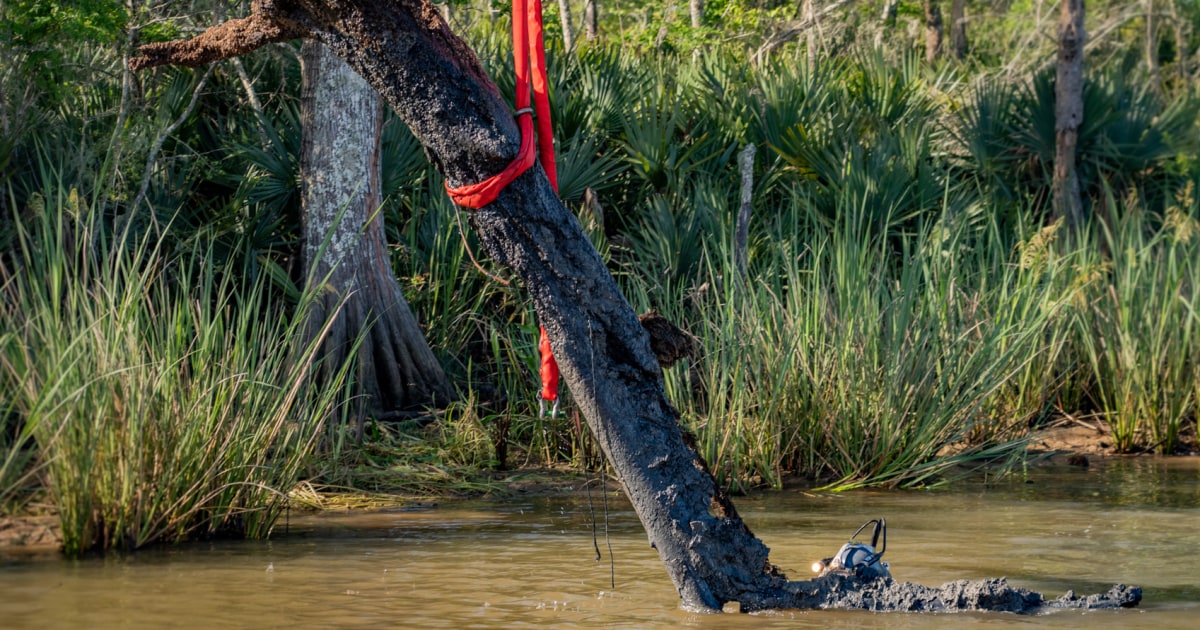
The castaway Clotilda has lain at the bottom of Mobile Bay for over a century. Selected artifacts will be displayed in special display tanks.

From oral history to science, unearthing the Clotilda has involved countless people, equipment, and, some might say, miracles. A journalist discovered the ship in 2018 and enlisted the University of Southern Mississippi to help survey the river. Coordinates and data were shared with the Alabama Historical Commission, which brought in divers and archaeological excavators. Everything was kept secret until the shocking news broke. formally announced in 2019.
James P. Delgado, Ph.D, a maritime archaeologist and senior vice president of Search Inc., helped lead the team of experts that conclusively verified the ship’s identity.
“We have to remember that this story happened not too long ago,” said Delgado, co-author of “Clotilda: The Archeology and History of the Last Slave Ship.” “It’s a story about people…and the continuing legacies of that journey.”
Since 2019, bringing that legacy to life has been the mission of Meg McCrummen Fowler, Ph.D., director of the Mobile History Museum, who has partnered with the Alabama Historical Commission, the Mobile County Commission, and the City of Mobile for easy display. The process also involved the local community, descendants and experts at the national level.
“As a curator, I have spent years reading and writing survivor stories,” McCrummen Fowler said. “You can’t do that and not be changed.”
Before the opening, he hopes visitors will not only “learn historical facts, but have an experience with history that highlights the humanity of history.”

Clotilde’s saga is full of humanity, underscored by the inhumanity of the institution of slavery.
This episode began with an Alabama businessman making a bet that he could get away with smuggling human goods. Seeking to cover up his crime once the Clotilda dropped anchor, he ordered the ship deliberately set on fire and scuttled. The captives were transferred to a steamboat, then forced into hiding in the wild Delta scrub, before being separated for eventual sale across the state and enslaved.
After Lincoln issued the Emancipation Proclamation in 1863, and slavery was fully abolished two years later, the survivors envisioned returning to Africa but lacked the financial means.
However, a group of them pooled their limited resources to purchase land, transforming the north end of Mobile into an independent community. Together they ruled Africatown and built houses, schools, churches and businesses. They maintained their heritage by continuing to speak their native languages and passed the traditions on to their children.
Throughout the years, Africatown’s descendants have proudly embraced their rich ancestral heritage.
Among them is Jeremy Ellis, a descendant of survivors Clotilda Pollee and Rose Allen, and president of the Clotilda Descendants Association. His mission is to honor the Clotilda’s ancestors; preserve culture, landmarks and legacies; and educate future generations of relatives and the community.
The exhibition “has been a long time in the making,” said Ellis, who also credited the original descendant organization, Africatown Direct Descendants of the Clotilda, with advocating since the early 1980s for such a museum. “They paved the way for this moment,” she said.
Altevese Lumbers-Rosario is the great-great-granddaughter of survivor Kossula Oluale (Cudjo Lewis) and vice president of CDA.
Lumbers-Rosario, who lived in Africatown as a child, believes “there is no other story like it in American history.”

“They used one of the largest and most significant atrocities in human history as the impetus to build an extraordinarily unique community that thrived for decades and provided every possible connection to their homeland on foreign soil,” Lumbers-Rosario said.
The Heritage House building, located in the heart of Africatown, is approximately 5,000 square feet and is painted a shade of blue to honor Clotilda survivors.
The exhibit will feature a memorial wall with the names of the 110 survivors. In the garden, there is also a memorial sculpture titled “The Memory Keeper”, which is a collaboration between ceramic artist Charles Smith and metal sculptor Frank Ledbetter.
The Clotilda is listed on the National Register of Historic Places, and there is said to be discussion about future narrated boat tours to the wreck site, which some consider sacred space.

Darron E. Patterson, former president of the Clotilda Descendants Association, is a native of Africatown and is the great-great-grandson of Clotilda survivor Pollee (“Kupollee”) Allen.
He said he hopes this chapter of American history will be used to galvanize and unify the country instead of dividing it.
As for the future of Africatown, he dreams of returning to “the vibrant community I grew up in, only better this time. We had stores, warehouses, movie theaters, drive-ins, our own post office, schools, churches… family systems that raised and educated children, and then sent them out into the world to make it a better place.
“My sincere hope is that this is a key step in a better future for the Africatown community.”


