

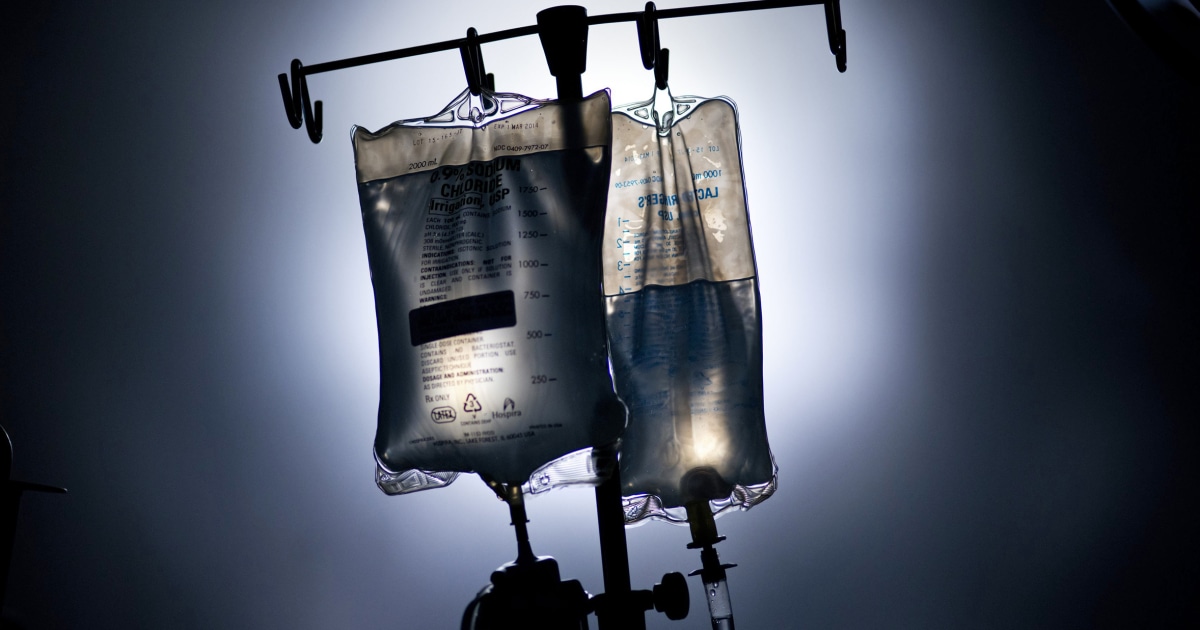
Widespread shortages of cancer drugs are forcing doctors to make difficult decisions about how to treat their patients, including rationing doses and switching to other treatment options with potentially more side effects.
As of Wednesday, the Food and Drug Administration listed 14 cancer drugs in shortage.
“The oncology shortage is especially critical,” FDA commissioner Dr. Robert Califf told NBC News. “I am a former intensive care physician and I am well aware of the consequences if you are unable to receive the necessary chemotherapy.”

according to a march report from the Senate Committee on Homeland Security and Government Affairs, drug shortages are at record levels. Shortages of new drugs increased by nearly 30% between 2021 and 2022. As of the end of 2022, there was a five-year record of 295 active drug shortages.
“I don’t know of a worse time than this,” said Dr. Julie Gralow, chief medical officer and executive vice president of the American Society of Clinical Oncology. “What’s different about this shortage is, I think, it’s just the broad applicability of these drugs, how important they are, globally, in the US, in treating so many diseases.”
Among the drugs in short supply is carboplatin, a chemotherapy agent used as a first-line treatment for several types of cancer.
“Carboplatin is a very important drug for the treatment of many types of cancer: breast cancer, ovarian cancer, head and neck cancer, lung cancer, among many others,” said Dr. Lucio Gordan, medical oncologist and president of Florida Cancer Specialists and Research Institute, a network of cancer clinics. Gordon said they were completely off the drug for almost two weeks.
“I’ve been doing this for over 20 years. This is the worst I have ever seen,” she said.
Florida Cancer Specialists knew the shortage was coming and tried to prepare. For the past few months, they’ve been rationing by reducing carboplatin doses by 10%, which Gordan says doesn’t diminish the drug’s effectiveness.
“We’ve been rounding down for a while,” he said. “But we just ran out of medicine, so there’s nothing to round off.”

Carrie Cherkinsky, 41, of Tallahassee, Florida, learned of the shortage through a Facebook support group for women with ovarian cancer. She was still surprised to learn that she would not be able to receive her second round of chemotherapy, scheduled for May 15, at Florida Cancer Specialists. Gordon was not involved in her care.
“Who is going to be held accountable for this?” said Cherkinsky, who was diagnosed with ovarian cancer in March. “For me not to receive the treatment that saved my life?”
Carboplatin is not just an effective drug; it is also less toxic and causes fewer side effects than other available drugs.
“However, one of the problems with these alternative medications is that they are often not as good, so survival outcomes can be compromised,” said Dr. Ángeles Alvarez Secord, president of the Society of Gynecologic Oncology.
Also, “when there’s more toxicity, there’s more cost for treatment because you’re dealing with side effects as well, or you’re giving additional drugs to try to prevent side effects,” Secord said. “So the alternatives often, even though they are present, still don’t meet the best standard of care.”
Across the country, hospitals and cancer centers have been forced to make similar decisions when it comes to cancer care.
According to a May survey by the Society for Gynecologic Oncology, doctors in at least 40 states are in short supply of at least one chemotherapy drug.
More news on drug shortages
Dr. Eleonora Teplinsky, a breast and gynecologic medical oncologist at Valley Health System in New Jersey, said the shortage is devastating.
“Cancer is life-changing the way it is, but you expect as a patient to walk into an office and receive the best there is,” Teplinsky said. “And right now we don’t have the best to give certain types of cancer.”
Drug shortages create additional stress not only for cancer patients, but also for medical providers. In addition to being in a workforce already burned out and exhausted by a pandemic, doctors have to scramble to find life-saving treatments.
“All the practices in the country, not just in oncology, have put a lot more stress on us since Covid,” Gordan said. “This is another curveball that prevents us from doing the best we can.”
Shortages can sometimes catch providers off guard.
Suppliers do not give notice when a drug is about to run out; they will simply stop filling all of their orders, said Andrea Iannucci, deputy chief pharmaceutical officer at UC Davis Health. “So we place an order and we think it’s going to arrive and it doesn’t arrive, because the drug was not available,” Iannucci said.
Keri Carvill, 44, of Sacramento, California, was diagnosed with triple-negative breast cancer in March, but was unable to receive her first dose of carboplatin until May 19. Triple negative breast cancer is a particularly aggressive form of the disease.
“It’s stressful and scary,” Carvill said.
What led to the shortage and what can fix it?
The current carboplatin shortage was caused in part by quality problems at a manufacturing plant, Intas Pharmaceuticals, in India, but experts say the real problem is more chronic.
“Unfortunately, the profitability of this industry is very low or non-existent,” Califf said. “Several companies are closing down or having quality problems due to the difficulty of investing in their technology. That is the main underlying reason for the shortage that we are seeing.”
In a statement to NBC News, Intas Pharmaceuticals said it is working with the FDA to release the existing inventory of carboplatin and other medically necessary products. It is also working with the agency on a plan to resume manufacturing, but added that a date has not yet been confirmed for when that will happen.
Califf said the FDA is working with other manufacturers to make more carboplatin available.
However, long-term solutions will require “intervention by Congress and the White House to put this industry in the right place,” he said, adding that a White House team has been working on the problem of drug shortages. .
Teplinsky, the New Jersey oncologist, said she has encouraged her social media followers to reach out to elected officials to advocate for the timely production of chemotherapy drugs and long-term policies to ensure this doesn’t happen again.
“Delaying care affects outcomes,” Teplinsky said. “So in this case, either we can’t give people what they need, or we have to wait, which we know will have negative consequences.”Continue NBC HEALTH in Twitter & Facebook.


