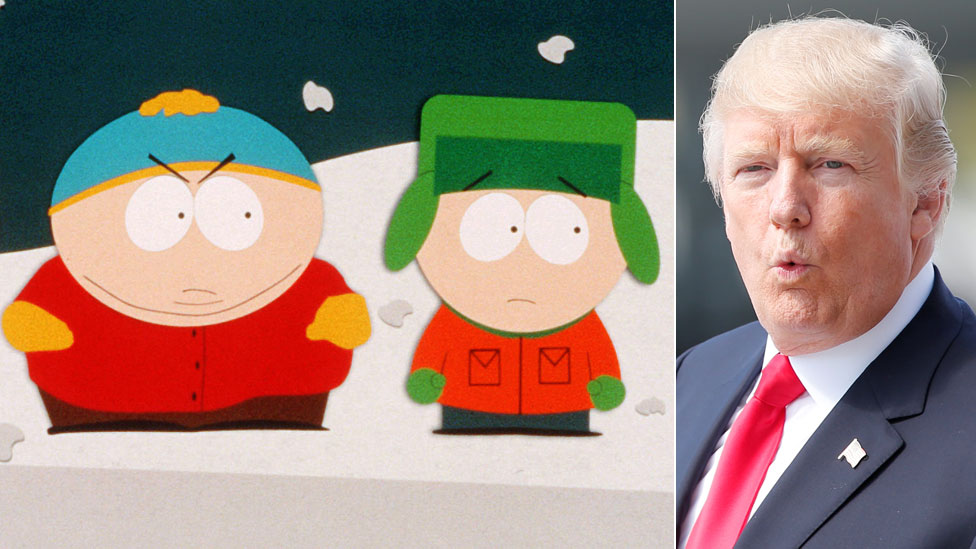
The creative minds behind South Park, Trey Parker and Matt Stone, have once again stirred attention with a characteristically irreverent response involving former U.S. President Donald Trump. Known for their sharp satire and fearless commentary on political and cultural figures, Parker and Stone used their platform to deliver what appeared to be a tongue-in-cheek “apology” that, true to form, was layered with irony rather than contrition.
Through the years, South Park has earned a name for itself by directly addressing controversial topics, frequently balancing between humor and analysis. The series has consistently aimed to underscore the ridiculousness of actual events by employing exaggerated comedy and sharp observations. Their most recent engagement with the Trump storyline maintains this practice, presenting viewers with another instance of how satire can both entertain and provoke thought.
The supposed apology was delivered through a satirical announcement—written in the familiar tone and style that the series’ followers recognize. Instead of providing a heartfelt apology, Parker and Stone seized the opportunity to comment on the present media landscape and societal conversation, especially in relation to figures as divisive as Trump. The announcement was presented not as an authentic surrender, but as a nuanced discussion on the culture of indignation, public criticism, and the intricate connection between entertainment and politics.
During the series’ progression, Donald Trump was frequently featured. The individual known as “Mr. Garrison” acted as an unmistakable satire of Trump during the 2016 elections and afterwards. The creators utilized this narrative to tackle wider issues related to leadership, populism, and societal response. Their depiction wasn’t meant to support or vilify, but to highlight the contradictions and dramatic elements inherent in today’s political realm.
In this most recent instance, the creators’ message seemed less about Trump himself and more about the performative nature of public apologies in today’s media landscape. The language used mimicked that of corporate or celebrity apologies—carefully crafted, publicly shared, and often scrutinized more for their tone than their content. Parker and Stone used this familiar structure to deliver a message that was, at its core, a critique of the performative apology trend that has permeated both political and entertainment spheres.
By presenting their message as an “apology,” the South Park creators introduced an additional aspect to their satire: the implication that in modern culture, even humor needs to proceed with caution. The irony was clear to viewers, many of whom noticed the intentional imitation of public relations language and the deeper discussion on censorship, freedom of expression, and the limits of satire.
Parker and Stone have continuously opposed attempts to restrict their material or alter their style, even when faced with considerable opposition. Their creative approach focuses on challenging boundaries and addressing tough topics through comedy, even if it causes discomfort among viewers. This bold attitude has garnered both acclaim and critique, and their newest move reinforces their refusal to adhere to outside demands.
The creators’ response also served to reaffirm their long-held belief that comedy plays a vital role in societal critique. In their view, laughter can challenge authority, provoke thought, and expose hypocrisy. By drawing attention to the mechanisms of modern discourse—especially the tendency to demand retractions or apologies for controversial content—they encourage audiences to question not only what they see on screen but also how they react to it.
Esta dinámica entre South Park y su audiencia ha cambiado a lo largo de los años. Lo que comenzó como una serie animada irreverente enfocada en humor inmaduro se ha desarrollado en una plataforma para un comentario cultural agudo y sofisticado, aunque a menudo directo. La capacidad del programa para estimular el debate mientras preserva su estilo irreverente es parte de lo que lo ha mantenido relevante por más de veinte años.
In lampooning both Trump and the culture that surrounds him, Parker and Stone are less interested in making political statements and more focused on exposing the mechanics of influence, power, and media consumption. Their comedy doesn’t ask audiences to take sides—it asks them to pay attention, to laugh at the absurdity, and to think critically about the systems that shape public opinion.
Although some audiences might perceive the creators’ approach as objectionable or unsuitable, others regard it as an essential counterbalance to the polished stories frequently shown in traditional media. This clash of viewpoints is precisely the realm in which South Park prospers, residing at the intersection of unease and humor, where satire functions as both a form of amusement and a method of critique.
The simulated apology aimed at Trump continues this tradition—a performative gesture designed not to mend but to mirror. It prompts the audience to ponder not just the target of the humor, but also the essence of the joke, the context of its creation, and the demands on creators in a period of increased awareness.
Parker and Stone have once again demonstrated their mastery of satire, using humor to critique not only political figures but also the cultural climate in which those figures exist. Whether one agrees with their approach or not, their work remains a provocative force in modern media—one that refuses to stay silent, back down, or deliver anything other than their unfiltered perspective.