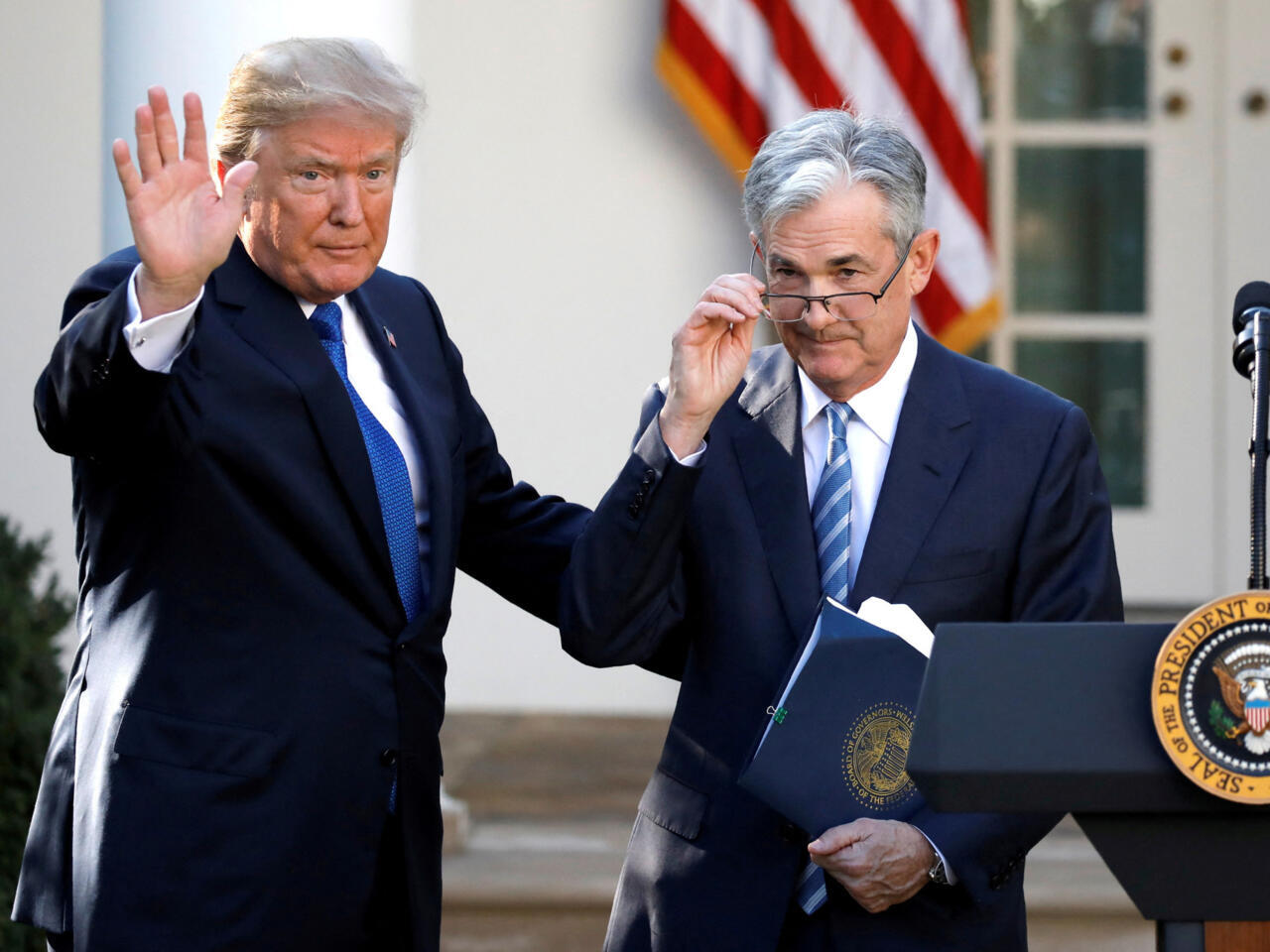
Investors moved quickly after reports emerged of a criminal probe involving Federal Reserve Chair Jerome Powell, stirring renewed worries about US financial stability.The disclosure prompted mild pullbacks in equities, fixed-income markets, and the dollar, underscoring anxiety about the Fed’s autonomy.
US equity markets began the session in negative territory after reports surfaced that federal prosecutors were examining Powell. The Dow Jones Industrial Average shed 159 points, or 0.32%, while the broader S&P 500 eased 0.14% and the tech-focused Nasdaq edged down 0.1%. The US dollar lost ground against major global currencies, with the dollar index slipping 0.35%, reflecting a cautious stance among currency traders. At the same time, Treasury yields inched higher, with the 10-year yield nearing 4.2%, close to its highest level in a month, indicating that mounting pressure on the Fed might push borrowing costs upward rather than paving the way for the rate cuts sought by the administration.
Unexpected shifts in market dynamics and growing volatility
The simultaneous downturn in stocks, bonds, and the dollar is unusual, since these assets typically shift in opposing directions. Wall Street’s volatility gauge, the VIX, leapt 6%, while precious metals saw a strong upswing. Gold futures rose 3%, hitting unprecedented highs above $4,600 per troy ounce, and silver jumped 8%, outstripping gold’s advance. Analysts characterized this as a mild resurgence of the “Sell America” trade, a phrase capturing investors’ wariness amid political pressure on monetary policy. Karl Schamotta, chief market strategist at Corpay, observed that although the reaction was measured, the trade highlighted persistent worries about the Fed’s autonomy.
The importance of the Fed’s autonomy
An independent central bank has long been considered a pillar of US financial stability, allowing monetary policy to be guided by economic indicators rather than political pressure. The Trump administration’s public criticism of Powell over interest rates challenged this principle, with the president seeking faster rate cuts to lower borrowing costs. While lower rates can benefit consumers through reduced credit card and loan rates, aggressive or premature cuts can unsettle investors, who may anticipate higher inflation and demand greater returns on US assets. This can push up Treasury yields and borrowing costs, counteracting the intended economic stimulus.
Analysts caution that a persistent sense that Fed independence is slipping may put downward pressure on the dollar, push up long-term rates, and intensify volatility across global markets. Schamotta noted that these effects would conflict with the administration’s publicly declared economic objectives, given that investor trust in the US financial system is strongly tied to the Fed’s reputation and freedom to act.
Historical backdrop and market recollection
Monday’s market movements mirror the “Sell America” trend seen in spring 2025, when concerns about Trump’s trade and economic agenda led investors to retreat from US assets. During that period, bonds and the dollar weakened, and equities hovered near bear‑market levels before rebounding as political strains subsided. Analysts note that today’s reactions remain measured, shaped by unease over Fed independence and insights gained from earlier bouts of volatility.
Krishna Guha, vice chairman at Evercore ISI, described the recent movements as “unambiguously risk off,” suggesting that the trade could gather momentum in the coming months. However, he also noted that the market may not experience a full-scale sell-off, as Powell remains in position for a limited time, there is no immediate threat of removal, and he has pledged to continue his monetary policy approach.
Precious metals and the dynamics of currency debasement
The renewed interest in gold and silver aligns with what Wall Street analysts call the “debasement trade.” In times of political uncertainty or doubts over central bank credibility, investors often flock to hard assets that are not tied to a government or institutional reputation. These assets provide a hedge against potential currency devaluation and rising debt concerns. The recent surge in precious metals underscores how investors seek stability in tangible assets when confidence in the financial system is shaken.
Markets experienced brief bouts of panic in 2025 when Trump openly criticized Powell, questioning his timing and competence. Analysts observed that investors had grown accustomed to political pressure on the Fed and typically did not react unless a tangible action occurred. The recent subpoenas and Powell’s responses may constitute such a “coordinating proof point,” potentially triggering more pronounced market reactions.
The developments involving Powell and the Fed underscore how political power and institutional independence must be carefully balanced, and investors are tracking these events closely as they assess potential threats to US financial stability and adjust to the broader effects of possible political pressure on monetary policy. As the year moves forward, market participants are expected to stay alert, with precious metals, Treasury yields, and equity markets continuing to signal persistent uncertainty.
Overall, the episode highlights how political events can reverberate across financial markets, reshaping investor behavior, altering asset values, and affecting perceptions of risk. Although short-term movements have remained restrained, the broader consequences for market confidence and the Fed’s independence will be monitored closely, influencing both domestic and global investment choices throughout 2026.