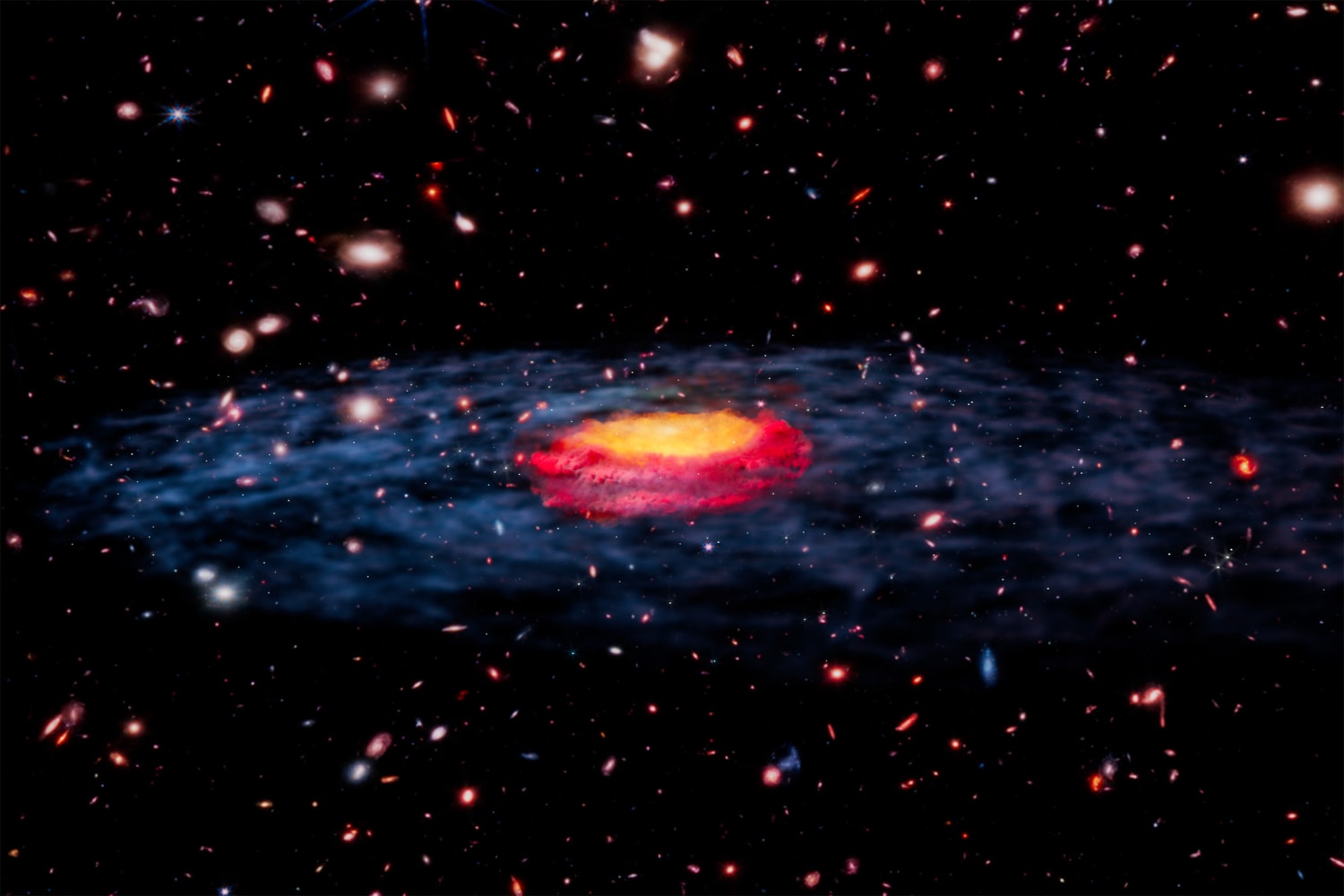
A team of international researchers has identified an enormous celestial object that provides an unprecedented window into the early universe. This newly discovered black hole, located approximately 13 billion light-years from Earth, possesses a mass roughly 300 million times greater than our sun, making it one of the most massive black holes ever observed from such a distant epoch.
The finding, achieved through cutting-edge telescopic methods and intricate data evaluation approaches, marks a notable advancement in astrophysics. What sets this specific black hole apart is not only its immense magnitude but also its age – the light detected by us commenced its voyage when the universe was under 700 million years of age. This turns the entity into a sort of cosmic time transporter, enabling researchers to examine the circumstances in the early universe.
Scientists utilized various astronomical observatories situated in space as well as ground-based telescopes to substantiate their results. Through examining how the black hole influences nearby materials and observing the unique radiation emissions from its accretion disk, the researchers validated both its enormous size and its status as one of the earliest supermassive black holes that emerged following the Big Bang. This finding presents challenges to current theories concerning the rapid formation of such vast entities in the context of the universe.
“This black hole shouldn’t have had enough time to grow to this size based on our current understanding of cosmic evolution,” explained Dr. Samantha Chen, lead astrophysicist on the discovery team. “Its existence forces us to reconsider our models of how the first supermassive black holes emerged in the early universe.”
In the core of an ancient galaxy lies an enormous celestial entity, with a gravitational force so strong that it distorts the very fabric of spacetime. The powerful radiation released by matter swirling into its event horizon offers essential insights into the chemical makeup of the early universe and the emergence of the initial galaxies.
Lo que los científicos encuentran especialmente notable es cómo este hallazgo actúa como una ventana hacia el pasado. La luz captada por los telescopios hoy salió de la proximidad del agujero negro cuando el universo tenía solo un 5% de su edad actual. Al estudiar estos objetos antiguos, los astrónomos obtienen información sobre el período enigmático conocido como la aurora cósmica, cuando las primeras estrellas y galaxias iluminaron el universo.
The analysis group employed gravitational lensing, a phenomenon anticipated by Einstein’s general relativity theory, to enhance the weak glow from this faraway object. This natural effect of magnification, generated by intervening clusters of galaxies twisting spacetime, enabled the detection of details that would be invisible even to our most advanced telescopes.
“This finding resembles uncovering a faultless fossil from the early days of the universe,” mentioned Dr. Michael Rodriguez, a cosmologist who did not participate in the research. “It provides concrete proof to evaluate our hypotheses on how the initial supermassive black holes emerged and expanded so rapidly following the Big Bang.”
The findings have sparked intense discussion in the astrophysics community about black hole formation mechanisms. Some theorists propose that direct collapse of enormous gas clouds in the early universe could create such massive black holes without going through the typical stellar evolution process. Others suggest mergers of smaller black holes might have occurred more efficiently than previously thought.
Future observations planned with next-generation telescopes like the James Webb Space Telescope and the upcoming Extremely Large Telescope aim to uncover more of these ancient cosmic giants. Each discovery helps piece together the puzzle of how the universe transitioned from its dark, formless beginnings to the structured cosmos we see today.
For astronomers, this black hole represents more than just a record-breaking object – it’s a key to understanding fundamental questions about cosmic evolution. As researchers continue analyzing the data, they hope to learn more about the relationship between early black holes and their host galaxies, potentially revealing how these gravitational powerhouses shaped the universe we inhabit today.
The discovery also has implications for our understanding of dark matter and dark energy, as the growth of supermassive black holes appears intimately connected with these mysterious components of the cosmos. By studying how this black hole and others like it evolved, scientists may uncover clues about the universe’s expansion and ultimate fate.
As technology advances, allowing us to peer further back in time, each new discovery like this brings us closer to answering humanity’s most profound questions about our cosmic origins and the fundamental nature of reality itself. This particular black hole, a relic from when the universe was in its infancy, promises to keep scientists busy for years to come as they decode its secrets.